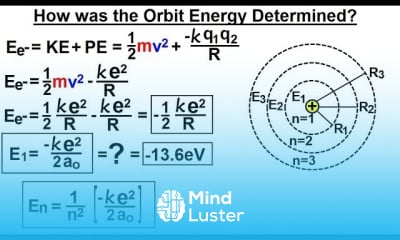
Determining Orbital Energies in Physics Course

 (51 reviews)
-
 60 Lessons
-
 9 Students
- Certificate of completion


Determining Orbital Energies course, in this course Explore the techniques and principles for calculating energy levels and properties of atomic and molecular orbitals.
 To Register in Course you have to watch at least 30 Second of any lesson
What You'll Learn
-
 Calculate atomic and molecular orbital energies using quantum mechanical principles and mathematical techniques
-
Apply Schrödinger equation solutions to determine orbital energy levels in atoms and molecules
-
Analyze the influence of electron configurations on orbital energies in various atomic and molecular systems
-
Utilize computational tools to model and predict orbital energies in complex chemical structures
-
Interpret spectroscopic data to infer orbital energy differences and electronic transitions
-
Assess the impact of electron-electron interactions on the stability and energy of atomic and molecular orbitals
-
Develop skills to compare and contrast different orbital energy models in quantum chemistry
-
Implement practical methods for calculating energy levels in diatomic and polyatomic molecules
-
Use orbital energy calculations to predict chemical reactivity and bonding properties
-
Evaluate the effects of external fields on orbital energies in atomic and molecular systems
-
Apply principles of orbital energy determination to design molecules with desired electronic properties
-
Integrate theoretical and computational approaches to accurately determine orbital energies in research
Course Content
60 Lessons • 4 h 51 m total

Physics Ch 66 5 Quantum Mechanics The Hydrogen Atom 8 of 78 How was Orbital Energy Determined
Physics E M Ch 41 1 Ohm s Law 39 of 42 How much Charge is Stored in a Car Battery
Calculus 3 Vector Calculus in 3 D 8 of 35 How to Determine if the Lines are Parallel
Calculus 3 Vector Calculus in 3 D 19 of 35 How to Calculate the Cross Product of 2 Vectors
Astronomy Ch 9 1 Earth s Atmosphere 7 of 61 How a Gas Molecule Absorbs Energy
Astronomy Ch 9 1 Earth s Atmosphere 9 of 61 How a Gas Molecule Absorbs Radiation
Astronomy Ch 9 1 Earth s Atmosphere 17 of 61 How Does CO2 Keep Us Warm
Astronomy Ch 9 1 Earth s Atmosphere 18 of 61 How Does H2O Keep Us Warm
Astronomy Ch 9 1 Earth s Atmosphere 19 of 61 How H2O Absorption Spectrum Compares to CO2
Astronomy Ch 9 1 Earth s Atmosphere 22 of 61 How is the Upper Atmosphere Heated
Astronomy Ch 9 1 Earth s Atmosphere 23 of 61 How is the Lower Atmosphere Heated Part 1
Astronomy Ch 9 1 Earth s Atmosphere 24 of 61 How is the Lower Atmosphere Heated Part 2
Astronomy Ch 10 Mercury 37 of 42 Messenger How does a Gamma Ray Spectrometer Work
Astronomy Ch 10 Mercury 37 of 42 Messenger How does a Gamma Ray Spectrometer Work
Astronomy Ch 10 Mercury 38 of 42 Messenger How does a X Ray Spectrometer Work
Astronomy Ch 10 Mercury 40 of 42 How was Mercury Insertion Accomplished
Astronomy Ch 9 1 Earth s Atmosphere 39 of 61 How Does Increasing CH4 Change G H Effect
Astronomy Ch 9 1 Earth s Atmosphere 39 of 61 How Does Increasing CH4 Change G H Effect
Astronomy Ch 9 1 Earth s Atmosphere 40 of 61 How Does Increasing N2O Change G H Effect
Geometry Ch 1 Basic Concepts 32 of 49 How to Determine the Perimeter
Geometry Ch 1 Basic Concepts 33 of 49 How to Determine the Area
Algebra Ch 0 5 Basic Concepts 2 of 26 How to Reduce Fractions
Electrical Engineering Ch 12 AC Power 11 of 38 When is Power Absorbed or Supplied
Electrical Engineering Ch 12 AC Power 11 of 38 When is Power Absorbed or Supplied
Electrical Engineering Ch 12 AC Power 12 of 38 How to Find Power Using Mesh Analysis Part 1
Electrical Engineering Ch 12 AC Power 13 of 38 How to find Power Using Mesh Analysis Part 2
Electrical Engineering Ch 12 AC Power 16 of 38 How to Find Maximum Power Transferred
Electrical Engineering Ch 12 AC Power 17 of 38 How to Find Max Power Transferred Derivation
Electrical Engineering Ch 12 AC Power 18 of 38 How to Find Max Power Transferred Summary
Electrical Engineering Ch 12 AC Power 18 of 38 How to Find Max Power Transferred Summary
Algebra Ch 0 5 Basic Concepts 12 of 26 How to Divide Fractions Finding the Quotient
Astronomy Ch 11 Venus 20 of 61 How Much Atmosphere does Venus Have
Algebra Ch 0 Basic Concepts 18 of 26 Adding Fractions Method 4 How to Find the LCD
Electrical Engineering Ch 12 AC Power 23 of 58 How to Calculate the RMS Current
Algebra Ch 0 5 Basic Concepts 25 of 26 How to Find the Prime Factors of a Number
Electrical Engineering Ch 12 AC Power 36 of 58 How to Calculate the Power Factor
Algebra Ch 0 6 Basic Concepts 23 of 36 How to Evaluate an Expression
Algebra Ch 0 6 Basic Concepts 25 of 36 How to combine Like Terms
Algebra Ch 0 6 Basic Concepts 27 of 36 How to Speak Algebra
Algebra Ch 1 Linear Equation 6 of 21 How to Solve Linear Equations Conceptual

How to Get The Certificate
-
You must have an
Account
on the platform.
-
Complete all lessons.
-
Watch at least 50% of Lesson Duration.
-
Get your Certificate free 🎉 !
4.4
(51 reviews)
Overall rating

Reviews
Be the First One Review This Course
Related Courses
View All
















Determining Orbital Energies in Physics Course Description
Determining Orbital Energies course, in this course Explore the techniques and principles for calculating energy levels and properties of atomic and molecular orbitals.
Focus on Learning, Not Ads
Experience the full power of Mindluster with Premium.
No distractions, just pure education.
Get Mindluster Premium
Cancel your subscription anytime
