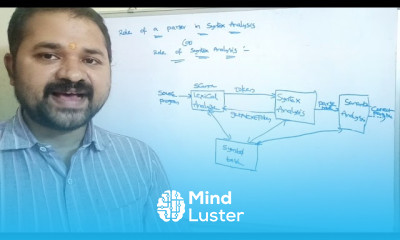
Language processing systems fundamentals Course

 (155 reviews)
-
 61 Lessons
-
 19 Students
- Certificate of completion


Language processing systems course in hindi, in this course we will learn about the fundamental components and techniques used in language processing systems. Starting with lexical analysis, we will explore how raw text is converted into tokens, the basic units of meaning. We will then delve into syntax analysis, where we study parsing techniques to understand the grammatical structure of sentences. Semantic analysis follows, focusing on how meaning is derived from syntactic structures. The course will also cover intermediate code generation, which serves as a bridge between high-level language and machine code. We'll discuss various code optimization techniques to enhance the efficiency of the generated code. Finally, we will explore code generation, converting intermediate representations into executable code. Additionally, the course will touch upon natural language processing (NLP) fundamentals and advanced topics, providing a comprehensive understanding of language processing systems. By the end of this course, students will have a solid foundation in designing and implementing language processing systems, ready to tackle real-world applications in compiler design, NLP, and more.
 To Register in Course you have to watch at least 30 Second of any lesson
What You'll Learn
-
 Understand and implement lexical analysis techniques for tokenizing raw text in language processing systems
-
Apply syntax analysis and parsing methods to interpret grammatical structures of sentences effectively
-
Perform semantic analysis to extract and derive meaning from syntactic structures in language processing
-
Design and develop intermediate code generation processes bridging high-level language and machine code
-
Optimize generated code using various techniques to improve efficiency and performance in language systems
-
Implement code generation strategies to convert intermediate representations into executable code
-
Explain fundamental concepts of natural language processing and their application in language systems
-
Analyze real-world language processing applications in compiler design and natural language processing systems
-
Utilize language processing tools and algorithms to develop efficient language understanding applications
-
Evaluate different parsing techniques and their suitability for specific language processing tasks
-
Integrate semantic analysis with syntax analysis to enhance language comprehension accuracy
-
Apply code optimization methods to improve runtime efficiency of language processing systems
-
Design language processing components for use in compiler construction and NLP projects
-
Demonstrate proficiency in developing language processing systems for practical, real-world applications
Course Content
61 Lessons • 21 h 40 m total

Language Processing System
Phases of a compiler in Compiler Design Examples CD
Phases of a compiler example1 in Compiler Design Examples CD
Phases of a compiler example2 in Compiler Design Examples CD
Grouping of phases into passes front end back end of the compiler Analysis part Synthesis part
Role of lexical Analyzer in Compiler Design Examples CD
Input Buffering
Specification of Tokens in Compiler Design
Recognition of Tokens in Compiler Design
LEX tool in compiler design
Compiler Construction Tools
Bootstrapping in Compiler Design
Role of a parser in compiler design
Derivation Tree Left Right Derivation Trees
Ambiguous Grammar
Elimination of left recursion Removal of Ambiguity in Grammar CFG TOC Compiler Design
Elimination of left factoring Removal of Ambiguity in Grammar CFG TOC Compiler Design
First and Follow in compiler design
LL 1 parser predictive parser non recursive predictive parsing
Recursive Descent parser
Backtracking in compiler design
What is Bottom Up Parsing
Handle and Handle Pruning
Shift reduce parser
Operator Precedence Parser in Compiler Design Example 1
Operator Precedence Parser in Compiler Design Example 2
SLR Parser in compiler design with solved example1
SLR Parser in compiler design with solved example2
SLR Parser in compiler design with solved example3
CLR Parser in compiler design with solved example1
CLR Parser in compiler design with solved example2
LALR parser in compiler design with solved example2
LALR Parser In Compiler Design with solved example1
YACC tool in compiler design YACC program to implement desk calculator
Syntax directed definition SDD in compier design Types of attributes Types of SDD
Syntax directed definition of simple desk calculator Annotated parse tree for 3 5 4n
Annotated parse tree for int a b c real a b c
Annotated parse tree for 3 5 Inherited attributes
Dependency Graph in Compiler Design
Syntax Directed Translation Translation scheme to convert infix to postfix expression

How to Get The Certificate
-
You must have an
Account
on the platform.
-
Complete all lessons.
-
Watch at least 50% of Lesson Duration.
-
Get your Certificate free 🎉 !
4.0
(155 reviews)
Overall rating

Reviews
Be the First One Review This Course
Related Courses
View All
















Language processing systems fundamentals Course Description
Language processing systems course in hindi, in this course we will learn about the fundamental components and techniques used in language processing systems. Starting with lexical analysis, we will explore how raw text is converted into tokens, the basic units of meaning. We will then delve into syntax analysis, where we study parsing techniques to understand the grammatical structure of sentences. Semantic analysis follows, focusing on how meaning is derived from syntactic structures. The course will also cover intermediate code generation, which serves as a bridge between high-level language and machine code. We'll discuss various code optimization techniques to enhance the efficiency of the generated code. Finally, we will explore code generation, converting intermediate representations into executable code. Additionally, the course will touch upon natural language processing (NLP) fundamentals and advanced topics, providing a comprehensive understanding of language processing systems. By the end of this course, students will have a solid foundation in designing and implementing language processing systems, ready to tackle real-world applications in compiler design, NLP, and more.
Focus on Learning, Not Ads
Experience the full power of Mindluster with Premium.
No distractions, just pure education.
Cancel your subscription anytime
