

BHUTAM PRANESH
good
 (1 review)
 6 Lessons
 41 Students
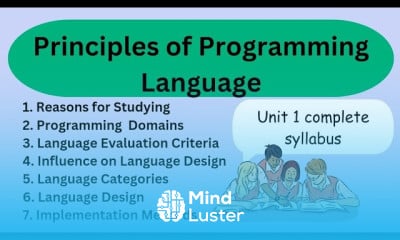
Programming languages principles course, in this course we will learn about the principles of programming languages. Programming Language Principles covers the fundamental concepts and theories underlying the design, implementation, and analysis of programming languages. We will explore the syntax and semantics of languages, understanding how they define the structure and meaning of programs. The course includes in-depth discussions on data types and structures, control structures, and the role of functions and procedures in modular programming. We will delve into different programming paradigms, including object-oriented and functional programming, examining their unique approaches and benefits. Memory management, concurrency, and parallelism will be covered, highlighting techniques for efficient and safe resource utilization. Additionally, the course will address exception handling mechanisms and their importance in robust program design. Students will learn about type systems and type checking, essential for ensuring program correctness. The course will also explore language translation and compilers, providing insights into how high-level code is transformed into executable form. By understanding these principles, students will be equipped to evaluate and utilize various programming languages effectively, enhancing their programming skills and broadening their understanding of software development. This course is essential for anyone aiming to deepen their knowledge of programming languages and their applications.
 To Register in Course you have to watch at least 30 Second of any lesson
 Understand core programming language concepts including syntax, semantics, and language design principles for effective software development
Apply knowledge of data types, control structures, and functions to write modular, efficient, and maintainable code in various programming paradigms
Analyze different programming paradigms such as object-oriented and functional programming to select appropriate approaches for specific projects
Evaluate memory management, concurrency, and parallelism techniques to optimize resource utilization and ensure program safety
Implement exception handling and type checking mechanisms to develop robust and error-resistant software applications
Explain the process of language translation, compilation, and interpretation to improve code performance and portability
6 Lessons • 4 h 9 m total
 You must have an
Account
on the platform.
Complete all lessons.
Watch at least 50% of Lesson Duration.
Get your Certificate free 🎉 !
5.0
(1 review)
Overall rating

Be the First One Review This Course
good

excellent

Good

good

Très pratique pour le développement personnel

Programming languages principles course, in this course we will learn about the principles of programming languages. Programming Language Principles covers the fundamental concepts and theories underlying the design, implementation, and analysis of programming languages. We will explore the syntax and semantics of languages, understanding how they define the structure and meaning of programs. The course includes in-depth discussions on data types and structures, control structures, and the role of functions and procedures in modular programming. We will delve into different programming paradigms, including object-oriented and functional programming, examining their unique approaches and benefits. Memory management, concurrency, and parallelism will be covered, highlighting techniques for efficient and safe resource utilization. Additionally, the course will address exception handling mechanisms and their importance in robust program design. Students will learn about type systems and type checking, essential for ensuring program correctness. The course will also explore language translation and compilers, providing insights into how high-level code is transformed into executable form. By understanding these principles, students will be equipped to evaluate and utilize various programming languages effectively, enhancing their programming skills and broadening their understanding of software development. This course is essential for anyone aiming to deepen their knowledge of programming languages and their applications.
Experience the full power of Mindluster with Premium.
No distractions, just pure education.
Cancel your subscription anytime