Afreen M
Loved the teachings and understood all the concepts
 (4 reviews)
 12 Lessons
 198 Students
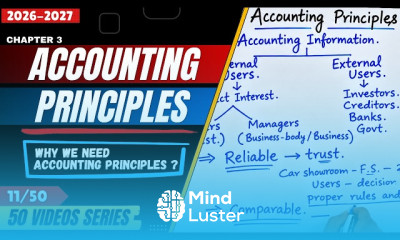
Accounting Concepts and Principles course, in this course we will learn about the Accounting Concepts and Principles, which form the foundation of financial accounting and reporting. Participants will explore key concepts such as the Accrual Concept, Matching Principle, Revenue Recognition Principle, and Historical Cost Principle. The course will cover the importance of the Consistency Principle, Prudence (Conservatism) Principle, and Going Concern Principle in ensuring accurate and reliable financial statements. Students will also delve into the Monetary Unit Assumption, Economic Entity Assumption, and Time Period Assumption, understanding their roles in standardizing accounting practices. The Full Disclosure Principle and Materiality Principle will be discussed to highlight their significance in providing comprehensive and relevant financial information. The Dual Aspect Concept and Realization Principle will be explained to show how they affect the recording and reporting of transactions. Additionally, the course will cover the Objectivity Principle, Relevance and Reliability Principle, and the Cost-Benefit Principle, emphasizing their roles in enhancing the quality of financial information.
 To Register in Course you have to watch at least 30 Second of any lesson
 Apply accrual and revenue recognition principles to ensure accurate financial reporting in real-world scenarios
Implement matching and historical cost principles to improve financial statement reliability and consistency
Analyze the impact of the going concern and prudence principles on financial decision-making and reporting
Utilize the monetary unit, economic entity, and time period assumptions to standardize accounting practices effectively
Evaluate the significance of full disclosure and materiality principles for transparent financial communication
Demonstrate understanding of the dual aspect and realization principles in transaction recording and reporting
Assess the importance of objectivity, relevance, and reliability principles in enhancing financial statement credibility
Integrate cost-benefit analysis to optimize financial reporting and decision-making processes
12 Lessons • 1 h 50 m total
 You must have an
Account
on the platform.
Complete all lessons.
Watch at least 50% of Lesson Duration.
Get your Certificate free 🎉 !
4.8
(4 reviews)
Overall rating

Be the First One Review This Course
Loved the teachings and understood all the concepts

Good

Amazing

GFOOD

Easy to understand, presented well
.

its transparent and understandable learning platform
great

Good

ok

asdfghjk
Excellent

Accounting Concepts and Principles course, in this course we will learn about the Accounting Concepts and Principles, which form the foundation of financial accounting and reporting. Participants will explore key concepts such as the Accrual Concept, Matching Principle, Revenue Recognition Principle, and Historical Cost Principle. The course will cover the importance of the Consistency Principle, Prudence (Conservatism) Principle, and Going Concern Principle in ensuring accurate and reliable financial statements. Students will also delve into the Monetary Unit Assumption, Economic Entity Assumption, and Time Period Assumption, understanding their roles in standardizing accounting practices. The Full Disclosure Principle and Materiality Principle will be discussed to highlight their significance in providing comprehensive and relevant financial information. The Dual Aspect Concept and Realization Principle will be explained to show how they affect the recording and reporting of transactions. Additionally, the course will cover the Objectivity Principle, Relevance and Reliability Principle, and the Cost-Benefit Principle, emphasizing their roles in enhancing the quality of financial information.
Experience the full power of Mindluster with Premium.
No distractions, just pure education.
Cancel your subscription anytime