
 4 Lessons
 289 Students



Malaika kamran
Gooooood
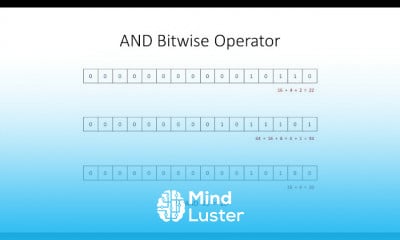
What is Bitwise operator? Bitwise operators are used to change individual bits in an operand. A single byte of computer memory-when viewed as 8 bits-can signify the true/false status of 8 flags because each bit can be used as a boolean variable that can hold one of two values: true or false. Are Bitwise Operators faster? Bitwise operations are incredibly simple and thus usually faster than arithmetic operations. For example to get the green portion of an rgb value, the arithmetic approach is (rgb / 256) % 256 . With bitwise operations you would do something as (rgb >> 8) & 0xFF.Why do we need Bitwise Operators? Bitwise operators are a great way to make very efficient use of space when representing data. ... Typically, integers are 32 bits, so this would mean sending back 64 bits of data. However, we can make this much more space-efficient by using bitwise operators. Why use Bitwise operators in C? BITWISE OPERATORS are used for manipulating data at the bit level, also called bit level programming. Bitwise operates on one or more bit patterns or binary numerals at the level of their individual bits. They are used in numerical computations to make the calculationWhat is Bitwise exclusive or? The bitwise exclusive OR operator ( ^ ) compares each bit of its first operand to the corresponding bit of its second operand. If the bit in one of the operands is 0 and the bit in the other operand is 1, the corresponding result bit is set to 1. Otherwise, the corresponding result bit is set to 0
 To Register in Course you have to watch at least 30 Second of any lesson
 Master bitwise operators to perform efficient data manipulation and space optimization in programming environments
Apply bitwise AND, OR, XOR, and NOT operations to solve real-world coding challenges and optimize algorithms
Utilize bitwise shift operators to enhance performance in low-level programming and hardware interfacing tasks
Implement bitwise techniques for data encoding, decoding, and flag management in software development
4 Lessons • 32 m total
You must have an
Account
on the platform.
Complete all lessons.
Watch at least 50% of Lesson Duration.
Get your Certificate free 🎉 !
4.2
 (55 reviews)
Overall rating

Be the First One Review This Course
Gooooood

Excellent

Good

Good
Nice
Useful
K
NTG
Good
Ok

Very good

Ok

What is Bitwise operator? Bitwise operators are used to change individual bits in an operand. A single byte of computer memory-when viewed as 8 bits-can signify the true/false status of 8 flags because each bit can be used as a boolean variable that can hold one of two values: true or false. Are Bitwise Operators faster? Bitwise operations are incredibly simple and thus usually faster than arithmetic operations. For example to get the green portion of an rgb value, the arithmetic approach is (rgb / 256) % 256 . With bitwise operations you would do something as (rgb >> 8) & 0xFF.Why do we need Bitwise Operators? Bitwise operators are a great way to make very efficient use of space when representing data. ... Typically, integers are 32 bits, so this would mean sending back 64 bits of data. However, we can make this much more space-efficient by using bitwise operators. Why use Bitwise operators in C? BITWISE OPERATORS are used for manipulating data at the bit level, also called bit level programming. Bitwise operates on one or more bit patterns or binary numerals at the level of their individual bits. They are used in numerical computations to make the calculationWhat is Bitwise exclusive or? The bitwise exclusive OR operator ( ^ ) compares each bit of its first operand to the corresponding bit of its second operand. If the bit in one of the operands is 0 and the bit in the other operand is 1, the corresponding result bit is set to 1. Otherwise, the corresponding result bit is set to 0
Experience the full power of Mindluster with Premium.
No distractions, just pure education.
Cancel your subscription anytime