This course was a wonderful learning experience. It helped me understand the basics of the German language, including vocabulary, grammar, pronunciation, and everyday conversations. The lessons were well-structured, easy to follow, and beginner-friendly. I have gained more confidence in learning German and feel motivated to continue improving my language skills. Thank you for providing such a valuable course.
What is covered in German A1? German A1 grammar covers the topics below: Articles (definite and indefinite) Singular and plural of nouns. Verbs and verb conjugation. Possessive pronouns.What is A1 level of German? At Expath's language schools in Berlin, we follow these guidelines in all of our German classes. These levels are classified as A1 for beginners, A2 for elementary, B1 for intermediate, B2 for upper intermediate, C1 as advanced, and C2 as mastery.How do I get a German A1 certificate? Goethe-Zertifikat A1: Start Deutsch 1 apply for a position as an au pair in Germany. obtain evidence of the language skills required to be granted a visa to join your husband or wife in Germany. prove that you have successfully reached level A1. be issued with an official and internationally recognized certificate.Is A1 German Easy? A1 is an easy level to clear and mostly aims at attracting new speakers towards the language while equipping them with the basics like introducing themselves and being able to pick up the core information from a given conversation or a text.How difficult is A1 German? If prepared for well, the A1 exam is very easy to pass. The test is divided in to four modules: Lesen, Schreiben, Hören and Sprechen. ... However do remember to go through the sample tests given on the goethe website. The real tough one for a beginner might be B1.Can I learn German in 1 year? German is a complex yet highly systematic language. It is possible to learn German in one year, but it will take a near full-time commitment and immersion learning.Is B2 German fluent? B2 is the first level that means that you can speak really fluent and understand 80% of the situations that you find yourself in repeatedly. You can prepare yourself for the exam and even see a sample of the language level here.
To Register in Course you have to watch at least 30 Second of any lesson
What You'll Learn
-
Basic German vocabulary including articles, nouns, and possessive pronouns for everyday communication
-
Fundamental German grammar concepts such as verb conjugation and sentence structure for beginners
-
Effective self-introduction and greeting skills in German for social and professional settings
-
Ability to understand and respond to simple questions and statements in German conversations
-
Recognition and use of singular and plural nouns in German to build foundational language skills
-
Basic comprehension of written German texts and simple listening exercises for beginners
-
Introduction to German pronunciation and basic phonetics for clear spoken communication
-
Confidence in completing simple written exercises and basic speaking tasks in German
-
Knowledge of A1 level certification requirements and how to obtain Goethe-Zertifikat A1
-
Practical skills to navigate common scenarios like shopping, dining, and travel in German-speaking environments
-
Understanding of the German alphabet, numbers, and essential vocabulary for daily use
-
Ability to identify and use common grammatical structures in simple German sentences
-
Preparation strategies for A1 German exams, including sample tests and practice modules
-
Motivation and foundational knowledge to continue progressing towards higher German language levels
Course Content
65 Lessons • 11 h 5 m total
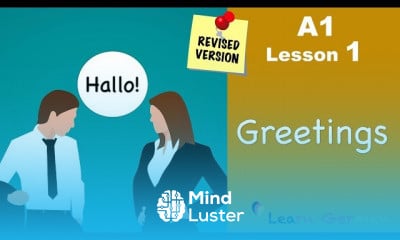
A1 Lesson 1 | Begrüßungen | Greetings | German for beginners | Learn German
A1 Lesson 2 | Common Phrases | German for beginners | Learn German
A1 Lesson 3 | Numbers 0 20 | Zahlen | German for beginners | Learn German
REVISED A1 Lesson 4 | Numbers 21 100 | Zahlen | German for beginners | Learn German
REVISED A1 Lesson 5 | Alphabets | das Alphabet | German for beginners | Learn German
REVISED A1 Lesson 6 | sich vorstellen | introducing yourself in German | Learn German
REVISED A1 Lesson 7 | jemanden kennenlernen | Getting to know someone | Learn German
REVISED A1 Lesson 8 | Wie geht s | How are you | Learn German
REVISED A1 Lesson 9 | Satzstruktur | Sentence Structure Part 1 | Learn German
REVISED A1 Lesson 10 | Satzstruktur | Sentence Structure Part 2 | Learn German
REVISED A1 Lesson 11 | Personalpronomen | Personal pronouns ich du wir | Learn German
REVISED A1 Lesson 12 | haben und sein | Verb conjugation | Learn German
REVISED A1 Lesson 13 | Was ist ein Verb | Verb structure in German | Learn German
REVISED A1 Lesson 14 | Regelmäßige Verben | Regular Verbs in German | Learn German
REVISED A1 Lesson 15 | Unregelmäßige Verben | Irregular Verbs in German | Learn German
REVISED A1 Lesson 16 | Numbers above 100 in German | Zahlen Teil 3 | Learn German
REVISED A1 Lesson 17 | Adjectives and Opposites | Adjektive und Gegenteile | Learn German
Learn German | How to introduce someone | Wer ist das | German for beginners | A1 Lesson 18
Learn German | Articles | bestimmte Artikel | der die das | German for beginners | A1 Lesson 19
Learn German | Articles | unbestimmte Artikel | ein eine | German for beginners | A1 Lesson 20
Learn German | Articles | negative Artikel | kein keine | German for beginners | A1 Lesson 21
Learn German | Time official | How to tell time | Zeit | German for beginners | A1 Lesson 22
Learn German | Time unofficial | How to tell time | Zeit | German for beginners | A1 Lesson 23
Learn German | Possessive Pronouns | Nominative case | German for beginners | A1 Lesson 24
Learn German | Family | Meine Familie | German for beginners | A1 Lesson 25
Learn German | Accusative case | Articles | Akkusativ | German for beginners | A1 Lesson 26
Learn German | Possessive Pronouns | Accusative case | German for beginners | A1 Lesson 27
Learn German | möchten | Modal verbs | Modalverben | German for beginners | A1 Lesson 28
Learn German | W Questions | W Fragen | German for beginners | A1 Lesson 29
Learn German | Ordering in a Restaurant | das Restaurant | German for beginners | A1 Lesson 30
Learn German | Personal Pronouns | Accusative Case | German for beginners | A1 Lesson 31
Learn German | Artikel im Dativ | Dative Case | German for beginners | A1 Lesson 32
Learn German | Ordinalzahlen | Ordinal numbers | German for beginners | A1 Lesson 33
Learn German | Zeit Fragewörter | Time related questions | German for beginners | A1 Lesson 34
Learn German | Dative case | Possessive pronouns | German for beginners | A1 Lesson 35
Learn German | Dative case | Personal pronouns | German for beginners | A1 Lesson 36
Learn German | Trennbare Verben | Separable verbs | German for beginners | A1 Lesson 37
Learn German | Tagesablauf | Daily routine | German for beginners | A1 Lesson 38
Learn German | Imperativ | Imperative | German for beginners | A1 Lesson 39
Learn German | Wegbeschreibung | Directions | German for beginners | A1 Lesson 40
How to Get The Certificate
-
You must have an Account on the platform.
-
Complete all lessons.
-
Watch at least 50% of Lesson Duration.
-
Get your Certificate free 🎉 !
4.7
(303 reviews)
Overall rating
Reviews
Be the First One Review This Course
Very Nice & Easy Learn Platform.
Simple and clear explanation for beginners. I like it!
good best leaning
Taki Aifaoui
Sono felice di essere promosso
It's nice
It's nice and easy to learn
كانت دراسه ممتعه
This course was a valuable and enjoyable learning experience. It helped me gain new knowledge and develop useful skills. The content was clear, well-organized, and easy to understand. I would like to thank the course organizers for their efforts, and I look forward to participating in more courses to improve my professional skills and knowledge.
best
O76r 03 r
A1 Learn German for beginners Course Description
What is covered in German A1? German A1 grammar covers the topics below: Articles (definite and indefinite) Singular and plural of nouns. Verbs and verb conjugation. Possessive pronouns.What is A1 level of German? At Expath's language schools in Berlin, we follow these guidelines in all of our German classes. These levels are classified as A1 for beginners, A2 for elementary, B1 for intermediate, B2 for upper intermediate, C1 as advanced, and C2 as mastery.How do I get a German A1 certificate? Goethe-Zertifikat A1: Start Deutsch 1 apply for a position as an au pair in Germany. obtain evidence of the language skills required to be granted a visa to join your husband or wife in Germany. prove that you have successfully reached level A1. be issued with an official and internationally recognized certificate.Is A1 German Easy? A1 is an easy level to clear and mostly aims at attracting new speakers towards the language while equipping them with the basics like introducing themselves and being able to pick up the core information from a given conversation or a text.How difficult is A1 German? If prepared for well, the A1 exam is very easy to pass. The test is divided in to four modules: Lesen, Schreiben, Hören and Sprechen. ... However do remember to go through the sample tests given on the goethe website. The real tough one for a beginner might be B1.Can I learn German in 1 year? German is a complex yet highly systematic language. It is possible to learn German in one year, but it will take a near full-time commitment and immersion learning.Is B2 German fluent? B2 is the first level that means that you can speak really fluent and understand 80% of the situations that you find yourself in repeatedly. You can prepare yourself for the exam and even see a sample of the language level here.
Focus on Learning, Not Ads
Experience the full power of Mindluster with Premium.
No distractions, just pure education.
Cancel your subscription anytime