



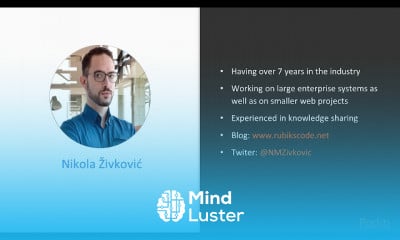

Aayush Kumar Jha
GOOD
 (176 reviews)
 51 Lessons
 49 Students
scikit-learn, in this course we will learn about scikit-learn, one of the most powerful and widely used machine learning libraries in Python. You will explore how to build and evaluate machine learning models using tools for classification, regression, clustering, dimensionality reduction, and model selection. The course will guide you through essential steps like data preprocessing, splitting datasets, choosing the right algorithms, and fine-tuning model performance with cross-validation and grid search. You will also work with pipelines to streamline workflows and manage complex ML tasks more efficiently. With hands-on examples and real-world datasets, you will gain practical skills to implement models that make accurate predictions. Whether you're a beginner or looking to solidify your ML foundation, this course will help you master machine learning with scikit-learn and apply it confidently in data science projects. Basic Python and data handling knowledge are recommended. Data School
 To Register in Course you have to watch at least 30 Second of any lesson
 Master machine learning classification, regression, clustering, and dimensionality reduction using scikit-learn in Python
Implement data preprocessing, dataset splitting, and feature engineering for robust machine learning models
Select appropriate algorithms and optimize model performance with cross-validation and grid search techniques
Build and evaluate machine learning models for real-world datasets in classification, regression, and clustering tasks
Create efficient workflows using pipelines to streamline complex machine learning processes
Apply model evaluation metrics to assess accuracy, precision, recall, and F1-score in predictive modeling
Perform hyperparameter tuning to enhance model performance and prevent overfitting in scikit-learn projects
Utilize model selection techniques to compare and choose the best algorithms for specific data science problems
Handle imbalanced datasets and perform feature scaling to improve model reliability and accuracy
Implement dimensionality reduction methods like PCA to simplify data and improve model efficiency
Develop end-to-end machine learning projects with scikit-learn, from data preprocessing to deployment
Gain practical skills to confidently apply scikit-learn in data science, analytics, and AI projects
51 Lessons • 5 h 41 m total

 You must have an
Account
on the platform.
Complete all lessons.
Watch at least 50% of Lesson Duration.
Get your Certificate free 🎉 !
4.3
(176 reviews)
Overall rating

Be the First One Review This Course
GOOD

good

good

scikit-learn, in this course we will learn about scikit-learn, one of the most powerful and widely used machine learning libraries in Python. You will explore how to build and evaluate machine learning models using tools for classification, regression, clustering, dimensionality reduction, and model selection. The course will guide you through essential steps like data preprocessing, splitting datasets, choosing the right algorithms, and fine-tuning model performance with cross-validation and grid search. You will also work with pipelines to streamline workflows and manage complex ML tasks more efficiently. With hands-on examples and real-world datasets, you will gain practical skills to implement models that make accurate predictions. Whether you're a beginner or looking to solidify your ML foundation, this course will help you master machine learning with scikit-learn and apply it confidently in data science projects. Basic Python and data handling knowledge are recommended. Data School
Experience the full power of Mindluster with Premium.
No distractions, just pure education.
Cancel your subscription anytime