

Dô-vaané Charles
Nice Class
 (144 reviews)
 20 Lessons
 2.6K Students
What is the difference between Mandarin and Chinese language? Here's the short answer: Mandarin is a form of the Chinese language. Some call it a dialect. Chinese is an umbrella language term that encompasses multiple dialects/languages, including Mandarin, Cantonese, Hakka, and more. When you look at it closely, there are actually over 200 dialects of Chinese! Is Mandarin a Chinese language? Mandarin language, also called Northern Chinese, Chinese (Pinyin) Guanhua (“Officials' Language”), or (Wade-Giles romanization) Kuan-hua, the most widely spoken form of Chinese.Why is Chinese language called Mandarin? When Jesuit missionaries learned this standard language in the 16th century, they called it "Mandarin", from its Chinese name Guānhuà (官话/官話) or 'language of the officials'.How do you speak basic Mandarin Chinese? Basic Mandarin Chinese Words and Phrases Hello: Nǐhǎo (Nee how) ... Thank you: Xièxiè (Shieh-shieh) ... You're welcome: Bù kèqì (Boo kuh-chi) ... Good morning: Zǎo (Zhow) ... Goodnight: Wǎn'ān (One-un) ... My name is…: Wǒ jiào... ( ... My friend's name is...: Wǒ de péngyǒu jiào…Is it hard to learn Mandarin Chinese? Mandarin Chinese Interestingly, the hardest language to learn is also the most widely spoken native language in the world. Mandarin Chinese is challenging for a number of reasons. ... But writing isn't the only difficult part of learning Mandarin. The tonal nature of the language makes speaking it very hard as wellDid Bruce Lee speak Mandarin? Bruce Lee spoke Cantonese which is from his upbringing in Hong Kong, where Cantonese is spoken, whereas Mandarin is spoken in China and other parts of Asia. But there's not much recorded evidence of him speaking Cantonese (there are some recordings though), he almost always seemed to speak English later on.Is Cantonese older than Mandarin? But generally speaking, Cantonese was evolved from Old Chinese while Mandarin from Middle Chinese. In other words, Cantonese saw its development earlier before Mandarin. ... Yes, modern Cantonese is more similar to older forms of spoken Chinese than Mandarin is.
 To Register in Course you have to watch at least 30 Second of any lesson
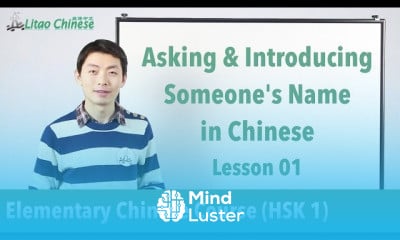
 Identify basic Mandarin Chinese greetings and common phrases for everyday communication using correct pronunciation and tone recognition
Demonstrate fundamental Mandarin vocabulary related to introductions, gratitude, and polite expressions in real-world conversations
Apply basic Mandarin sentence structures to form simple questions and statements for beginner-level dialogues
Recognize and differentiate between Mandarin Chinese tones and pronunciation to improve speaking accuracy and comprehension
Utilize essential Mandarin vocabulary to introduce oneself and others confidently in social and formal settings
Translate simple English phrases into Mandarin Chinese accurately, focusing on correct word order and tone usage
Develop foundational listening skills to understand basic Mandarin phrases and respond appropriately in common scenarios
Implement effective strategies for learning Mandarin pronunciation, tones, and vocabulary to facilitate ongoing language acquisition
20 Lessons • 1 h 59 m total
 You must have an
Account
on the platform.
Complete all lessons.
Watch at least 50% of Lesson Duration.
Get your Certificate free 🎉 !
4.5
(144 reviews)
Overall rating

Be the First One Review This Course
Nice Class

Much better than anyother platform to enhance skills

Very impactful, highly recommended to others

I absolutely enjoyed my HSK Level 1 course. The lessons were concise, simple and easy to assimilate. Kudos to the laoshi who is always articulate and detailed.

moi je veut que vous traduser en francais
good

good

Understood perfectly..

great

我很开心。谢谢你们

Easy to understand

very Informative

What is the difference between Mandarin and Chinese language? Here's the short answer: Mandarin is a form of the Chinese language. Some call it a dialect. Chinese is an umbrella language term that encompasses multiple dialects/languages, including Mandarin, Cantonese, Hakka, and more. When you look at it closely, there are actually over 200 dialects of Chinese! Is Mandarin a Chinese language? Mandarin language, also called Northern Chinese, Chinese (Pinyin) Guanhua (“Officials' Language”), or (Wade-Giles romanization) Kuan-hua, the most widely spoken form of Chinese.Why is Chinese language called Mandarin? When Jesuit missionaries learned this standard language in the 16th century, they called it "Mandarin", from its Chinese name Guānhuà (官话/官話) or 'language of the officials'.How do you speak basic Mandarin Chinese? Basic Mandarin Chinese Words and Phrases Hello: Nǐhǎo (Nee how) ... Thank you: Xièxiè (Shieh-shieh) ... You're welcome: Bù kèqì (Boo kuh-chi) ... Good morning: Zǎo (Zhow) ... Goodnight: Wǎn'ān (One-un) ... My name is…: Wǒ jiào... ( ... My friend's name is...: Wǒ de péngyǒu jiào…Is it hard to learn Mandarin Chinese? Mandarin Chinese Interestingly, the hardest language to learn is also the most widely spoken native language in the world. Mandarin Chinese is challenging for a number of reasons. ... But writing isn't the only difficult part of learning Mandarin. The tonal nature of the language makes speaking it very hard as wellDid Bruce Lee speak Mandarin? Bruce Lee spoke Cantonese which is from his upbringing in Hong Kong, where Cantonese is spoken, whereas Mandarin is spoken in China and other parts of Asia. But there's not much recorded evidence of him speaking Cantonese (there are some recordings though), he almost always seemed to speak English later on.Is Cantonese older than Mandarin? But generally speaking, Cantonese was evolved from Old Chinese while Mandarin from Middle Chinese. In other words, Cantonese saw its development earlier before Mandarin. ... Yes, modern Cantonese is more similar to older forms of spoken Chinese than Mandarin is.
Experience the full power of Mindluster with Premium.
No distractions, just pure education.
Cancel your subscription anytime