

 17 Lessons
 10 Students


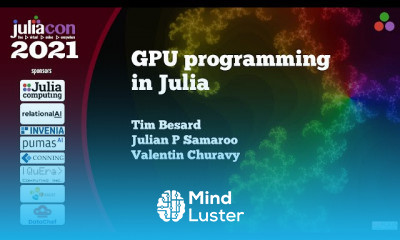
Julia is a fast dynamic-typed language that just-in-time (JIT) compiles into native code using LLVM It "runs like C but reads like Python", meaning that is blazing fast, easy to prototype and read/write code.
 To Register in Course you have to watch at least 30 Second of any lesson
What You'll Learn
-
 Master Julia programming for high-performance computing, data analysis, and scientific research using JIT compilation and LLVM optimization techniques
-
Develop efficient algorithms and data structures in Julia for real-world applications in machine learning, numerical analysis, and data visualization
-
Implement Julia code that leverages its dynamic typing, readability, and speed for rapid prototyping and software development projects
-
Optimize Julia programs for speed and memory management, utilizing best practices in performance tuning and debugging
-
Integrate Julia with existing tools and libraries for seamless workflows in data science, scientific computing, and computational research
-
Apply Julia's features to build scalable, maintainable, and robust applications in diverse technical domains
-
Utilize Julia's ecosystem for parallel computing, GPU acceleration, and distributed systems to handle large-scale data processing
-
Create and deploy Julia-based solutions that enhance productivity and innovation in scientific and technical industries
Course Content
17 Lessons • 55 m total

Fitting Plate reader Curves with Julia | Thomas A Poulsen | JuliaCon2021
Probabilistic K nearest Neighbours | Gerardo Duran Martin | JuliaCon2021
Speeding up cosmological data analysis with Julia | Marco Bonici | JuliaCon2021
Julia for end to end financial analysis | Mohammed Zahran | JuliaCon2021
Musical Julia | Radhika Ivaturi | JuliaCon2021
Theory is nearly implementation with Julia types | Gregor Kappler | JuliaCon2021
Processing Light Sheet Microscopy Data Using Julia | Mark Kittisopikul Ph D | JuliaCon2021
Strengths and Challenges of Julia for learning Linear Algebra | John Woolverton | JuliaCon2021
Jumping into the Julia Community via Advent Of Code | Jasmine Hughes | JuliaCon2021
Applications of Julia for Network Science Text Analysis | Mira Tellegen | JuliaCon2021
Bootstrapping Data Science and Diversity | Matthew A Tillman Hart Sam Urmy | JuliaCon2021
Disrupting Esoteric Language Microbenchmarks with an 70 line JIT | Seth Chapman | JuliaCon2021
Simulation of additive manufacturing processes in Julia | Luca Lubeto | JuliaCon2021
High Performance Tsunami Forecasting | Tuomas Koskela | JuliaCon2021
Sonification Exploring streaming data using live music coding | Nicki Cartlidge | JuliaCon2021
Julia as a framework for a Theoretical Physics PhD | Alejandro R Urzúa | JuliaCon2021
Awesome Computer Vision Done Quick | Bishmer Sekaran | JuliaCon2021
How to Get The Certificate
-
You must have an
Account
on the platform.
-
Complete all lessons.
-
Watch at least 50% of Lesson Duration.
-
Get your Certificate free 🎉 !


4.2
 (31 reviews)
Overall rating

Reviews
Be the First One Review This Course
Related Courses
View All




Juliacon Course Description
Julia is a fast dynamic-typed language that just-in-time (JIT) compiles into native code using LLVM It "runs like C but reads like Python", meaning that is blazing fast, easy to prototype and read/write code.
Focus on Learning, Not Ads
Experience the full power of Mindluster with Premium.
No distractions, just pure education.
Cancel your subscription anytime
