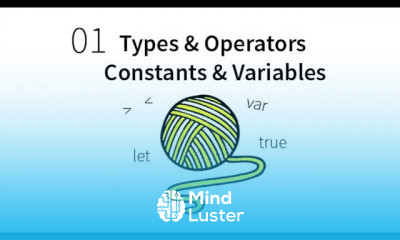

 56 Lessons
 2 Students


Programs are made up of statements, executed sequentially. More than one statement is allowed per editor line when separated by a semicolon ( ; ). Units of work in Swift are modularized using functions and organized into types. Functions accept one or more parameters, and return values .
 To Register in Course you have to watch at least 30 Second of any lesson
What You'll Learn
-
 Write Swift syntax for statements, expressions, and control flow to develop functional programs using modern programming techniques
-
Implement modular Swift code by defining and calling functions with parameters and return values for efficient software development
-
Organize Swift code into types such as classes, structs, and enums to create reusable and maintainable applications
-
Utilize Swift syntax to write clear, concise, and error-free code for mobile app development and software projects
-
Apply best practices for Swift programming syntax to improve code readability, performance, and debugging skills
-
Use Swift functions to accept parameters and return values, enabling dynamic and flexible program behavior
-
Develop understanding of statement execution order and control flow to manage program logic effectively
-
Leverage Swift syntax for statements and semicolons to write compact, efficient code in real-world programming scenarios
-
Create modular Swift programs by organizing code into functions and types for scalable software solutions
-
Implement Swift syntax for statements, functions, and types to build robust mobile applications and software tools
-
Utilize Swift programming syntax to enhance problem-solving skills in software development projects
-
Apply Swift syntax knowledge to write maintainable, efficient, and scalable code for various programming tasks
Course Content
56 Lessons • 1 h 43 m total

Course Introduction
Swift Types
Operators
Strings
A String isn t just a String
Constants and Variables
Let vs Var
End of Lesson 1
Optionals
No Nil
The Optional Type effects placeholder
Declaring Optionals with Question Marks
Unwrapping Optionals with if let
Optional Chaining
Implicitly Unwrapped Optionals
Casting with s and s
End of Lesson 02
Collections Arrays and Dictionaries
Array Operations
Dictionary Initialization
Dictionary Operations
Sets
End of Lesson 3
Control Flow
While Loop
if else Statements
Switch Statements
Self contained Chunks of Code
Anatomy of a Function
External Local Parameter Names
Practice Defining and Calling Functions firstCharacterOf
Functions Practice placeFirstLetterLast
Practice Defining and Calling Functions filterByYear
Class Properties and Methods
Where is the Header File
Properties
Type Properties Computed Properties
Calling Instance and Type Methods
End of Lesson 06
Enumerations

How to Get The Certificate
-
You must have an
Account
on the platform.
-
Complete all lessons.
-
Watch at least 50% of Lesson Duration.
-
Get your Certificate free 🎉 !
4.2
 (94 reviews)
Overall rating

Reviews
Be the First One Review This Course
Related Courses
View All




Swift Programming Syntax Course Description
Programs are made up of statements, executed sequentially. More than one statement is allowed per editor line when separated by a semicolon ( ; ). Units of work in Swift are modularized using functions and organized into types. Functions accept one or more parameters, and return values .
Focus on Learning, Not Ads
Experience the full power of Mindluster with Premium.
No distractions, just pure education.
Cancel your subscription anytime
