Super
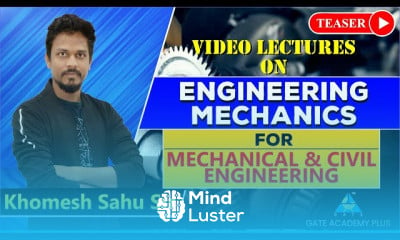
Mechanical engineering is an engineering branch that combines engineering physics and mathematics principles with materials science to design, analyze, manufacture, and maintain mechanical systems. It is one of the oldest and broadest of the engineering branches. Engineering Mechanics Rigid-body Mechanics • a basic requirement for the study of the mechanics of deformable bodies and the mechanics of fluids (advanced courses). • essential for the design and analysis of many types of structural members, mechanical components, electrical devices, etc, encountered in engineering.
To Register in Course you have to watch at least 30 Second of any lesson
What You'll Learn
-
Apply principles of rigid-body mechanics to analyze static and dynamic mechanical systems effectively
-
Utilize free-body diagrams and equilibrium equations to solve real-world engineering problems involving forces and moments
-
Calculate stresses, strains, and deformation in structural members using mechanics of materials concepts
-
Design mechanical components considering load distribution, material properties, and safety factors
-
Analyze the motion of rigid bodies using kinematic and kinetic principles for practical engineering applications
-
Evaluate the stability of structures and mechanical systems under various loading conditions
-
Implement mathematical models to predict the behavior of mechanical systems in engineering design
-
Utilize engineering software tools for simulation and analysis of mechanical systems and structures
Course Content
73 Lessons • 77 h 15 m total
Video Lectures on Engineering Mechanics by Khomesh Sahu Sir
Lecture 01 | Introduction to Engineering Mechanics | Engineering Mechanics
Lecture 2 | Module 1 | Fundamental of Engineering Mechanics Part 1 | Engineering Mechanics
Lecture 3 | Module 1 | Fundamental of Engineering Mechanics Part 2 | Engineering Mechanics
Best Books For Engineering Mechanics
Lecture 4 | Module 2 | Resultant Force and Low of Parallelogram | | Engineering Mechanics
Lecture 5 | Module 2 | Law of Triangle | Engineering Mechanics
Lecture 6 | Module 2 | Problems Based on Law of Parallelogram and Law | Engineering Mechanics
Lecture 7 | Module 2 | Resolution of Force | Engineering Mechanics
Lecture 8 | Module 2 | Problems on Force Resolution | Engineering Mechanics
Lecture 9 | Module 2 | Equilibrium Equation and Free Body Diagram | Engineering Mechanics
Lecture 10 | Module 2 | Lami s Theorem and Problems | Engineering Mechanics
Lecture 11 | Module 2 | Problems Based on Co planner Concurrent Force | Engineering Mechanics
Lecture 12 | Module 2 | Problems Based on Co planner Concurrent Force | Engineering Mechanics
Lecture 13 | Module 2 | Problems Based on Co planner Concurrent Force | Engineering Mechanics
Lecture 14 | Module 3 | Moment of Force and Moment of Couple | Engineering Mechanics
Lecture 15 | Module 3 | Force Couple System | Engineering Mechanics
Lecture 16 | Module 3 | Varignon s Theorem and Problem | Engineering Mechanics
Lecture 17 | Module 3 | Equilibrium Equation in Co planner Non concurrent | Engineering Mechanics
Lecture 18 | Module 3 | Problem on Varignon s Theorem Doubt Clearing | Engineering Mechanics
Lecture 19 | Module 3 | Problems Based on Co planner Non concurrent Force | Engineering Mechanics
Lecture 20 | Module 3 | Problems Based on Co planner Non concurrent Force | Engineering Mechanics
Lecture 21 | Module 3 | Concept of Internal Hinge Problem | Engineering Mechanics
Lecture 22 | Module 4 | Basic Introduction of Truss Types of Truss | Engineering Mechanics
Lecture 23 | Module 4 | Basic Assumptions For Plane Truss Analysis | Engineering Mechanics
Lecture 24 | Module 4 | Concept of Joint Method | Engineering Mechanics
Lecture 25 | Module 4 | Problems on Joint Method Conceptual Problem 1 | Engineering Mechanics
Lecture 26 | Module 4 | Problems on Joint Method Part 2 | Engineering Mechanics
Lecture 27 | Module 4 | Problems on Joint Method Part 3 | Engineering Mechanics
Lecture 28 | Module 4 | Important Results During Analysis of Plane Truss | Engineering Mechanics
Lecture 29 | Module 4 | Statically Determinate truss Statically | Engineering Mechanics
Lecture 30 | Module 4 | Doubt Clearing Session With Problems | Engineering Mechanics
Lecture 31 | Module 4 | Problems Based on Joint Method Part 4 | Engineering Mechanics
Lecture 32 | Module 4 | Concept of Section Method | Engineering Mechanics
Lecture 33 | Module 4 | Problems Based on Section Method Part 1 | Engineering Mechanics
Lecture 34 | Module 4 | Problems Based on Section Method Part 2 | Engineering Mechanics
Lecture 35 | Module 4 | Problems Based on Section Method Part 3 | Engineering Mechanics
Lecture 36 | Module 4 | Concept of Zero Force Member ZFM | Engineering Mechanics
Lecture 37 | Module 4 | Problems on Zero Force Member ZFM | Engineering Mechanics
Lecture 38 | Module 5 | Virtual Work | Engineering Mechanics
How to Get The Certificate
-
You must have an Account on the platform.
-
Complete all lessons.
-
Watch at least 50% of Lesson Duration.
-
Get your Certificate free 🎉 !
4.5
(73 reviews)
Overall rating
Reviews
Be the First One Review This Course
nice
It was a truly informative and inspiring knowledge sharing event. I have really learned a lot of contemporary research aspects from this scholarly event. Thank you very much.

very educative
Good
Is nice going through this course.
excellent

Absolutely educative
C'est une excellente formation ! Je partage le site avec mes amies pour qu’elles puissent en profiter également
Cool

Good
Super
Engineering Mechanics Course Description
Mechanical engineering is an engineering branch that combines engineering physics and mathematics principles with materials science to design, analyze, manufacture, and maintain mechanical systems. It is one of the oldest and broadest of the engineering branches. Engineering Mechanics Rigid-body Mechanics • a basic requirement for the study of the mechanics of deformable bodies and the mechanics of fluids (advanced courses). • essential for the design and analysis of many types of structural members, mechanical components, electrical devices, etc, encountered in engineering.
Focus on Learning, Not Ads
Experience the full power of Mindluster with Premium.
No distractions, just pure education.
Cancel your subscription anytime