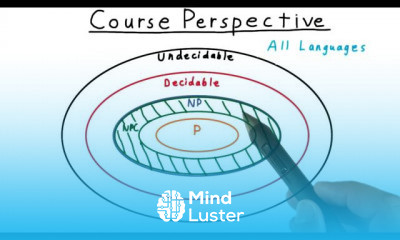

 189 Lessons
 5 Students


When we analyse an algorithm, we use a notation to represent its time complexity and that notation is Big O notation. For Example: time complexity for Linear search can be represented as O(n) and O(log n) for Binary search (where, n and log(n) are the number of operations) .
 To Register in Course you have to watch at least 30 Second of any lesson
What You'll Learn
-
 Understand and analyze algorithm complexity using Big O notation for various algorithms including linear and binary search
-
Apply Big O notation to evaluate and compare algorithm efficiency in real-world scenarios
-
Identify different types of algorithm complexities such as linear, logarithmic, quadratic, and exponential
-
Develop skills to optimize algorithms based on their time complexity for improved performance
-
Interpret algorithm performance metrics to make informed decisions in software development
-
Utilize complexity analysis to troubleshoot and improve existing algorithms in practical applications
-
Differentiate between best, average, and worst-case complexities in algorithm analysis
-
Implement algorithms with optimal time complexity for large-scale data processing and computational tasks
-
Assess the impact of algorithm complexity on system scalability and resource management
-
Design algorithms with efficient complexity to enhance application speed and responsiveness
-
Evaluate the trade-offs between algorithm complexity and implementation complexity
-
Apply complexity analysis techniques to real-world problems in data structures and algorithms
-
Use Big O notation to predict algorithm behavior and performance in different input scenarios
-
Analyze the complexity of recursive and iterative algorithms for better optimization
-
Compare the efficiency of different algorithms solving the same problem using complexity metrics
-
Integrate complexity analysis into software development lifecycle for performance tuning
Course Content
189 Lessons • 4 h 53 m total

Intro to Algorithms Georgia Tech Computability Complexity Theory Algorithms
Introduction Georgia Tech Computability Complexity Theory Algorithms
Lesson Plan Georgia Tech Computability Complexity Theory Algorithms
Optimal Similar Substructure GT Computability Complexity Theory Algorithms
Edit Distance Problem Georgia Tech Computability Complexity Theory Algorithms
Sequence Alignment Cost Quiz GT Computability Complexity Theory Algorithms
Sequence Alignment Cost Solution GT Computability Complexity Theory Algorithms
Prefix Substructure Georgia Tech Computability Complexity Theory Algorithms
Sequence Alignment Algorithm GT Computability Complexity Theory Algorithms
Sequence Alignment Exercise GT Computability Complexity Theory Algorithms
Sequence Alignment Solution GT Computability Complexity Theory Algorithms
Sequence Alignment Summary GT Computability Complexity Theory Algorithms
Chain Matrix Multiplication Georgia Tech Computability Complexity Theory Algorithms
Subchain Substructure Georgia Tech Computability Complexity Theory Algorithms
CMM Algorithm Georgia Tech Computability Complexity Theory Algorithms
CMM Exercise Quiz Georgia Tech Computability Complexity Theory Algorithms
CMM Exercise Solution Georgia Tech Computability Complexity Theory Algorithms
CMM Summary Georgia Tech Computability Complexity Theory Algorithms
All Pairs Shortest Path Georgia Tech Computability Complexity Theory Algorithms
Shortest Path Substructure GT Computability Complexity Theory Algorithms
The Floyd Warshall Algorithm GT Computability Complexity Theory Algorithms
Floyd Warshall Algorithm Exercise GT Computability Complexity Theory Algorithms
Floyd Warshall Algorithm Georgia Tech Computability Complexity Theory Algorithms
All Pairs Summary Georgia Tech Computability Complexity Theory Algorithms
Transitive Closure Georgia Tech Computability Complexity Theory Algorithms
Dynamic Programming Conclusion GT Computability Complexity Theory Algorithms
Introduction Georgia Tech Computability Complexity Theory Algorithms
Prerequisites Georgia Tech Computability Complexity Theory Algorithms
Convolution Georgia Tech Computability Complexity Theory Algorithms
Representations of Polynomials GT Computability Complexity Theory Algorithms
Multiplying Polynomials Georgia Tech Computability Complexity Theory Algorithms
Multiplication Exercise Quiz GT Computability Complexity Theory Algorithms
Multiplication Exercise Solution GT Computability Complexity Theory Algorithms
Multiplying Polynomials Continued GT Computability Complexity Theory Algorithms
Divide and Conquer Inspiration GT Computability Complexity Theory Algorithms
Roots of Unity Georgia Tech Computability Complexity Theory Algorithms
FFT Example Georgia Tech Computability Complexity Theory Algorithms
FFT Exercise Quiz Georgia Tech Computability Complexity Theory Algorithms
FFT Exercise Solution Georgia Tech Computability Complexity Theory Algorithms
FFT Algorithm Georgia Tech Computability Complexity Theory Algorithms

How to Get The Certificate
-
You must have an
Account
on the platform.
-
Complete all lessons.
-
Watch at least 50% of Lesson Duration.
-
Get your Certificate free 🎉 !
4.0
 (29 reviews)
Overall rating

Reviews
Be the First One Review This Course
Related Courses
View All














Complexity Algorithms Course Description
When we analyse an algorithm, we use a notation to represent its time complexity and that notation is Big O notation. For Example: time complexity for Linear search can be represented as O(n) and O(log n) for Binary search (where, n and log(n) are the number of operations) .
Focus on Learning, Not Ads
Experience the full power of Mindluster with Premium.
No distractions, just pure education.
Cancel your subscription anytime
