
 22 Lessons
 234 Students


Bruno Rodrigues
Try to do thos in English language next time. Thanks
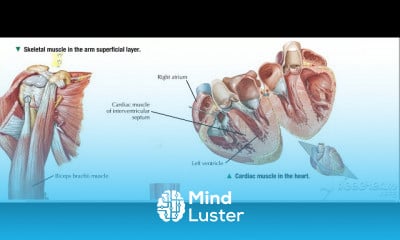
The muscular system is an organ system consisting of skeletal, smooth and cardiac muscles. It permits movement of the body, maintains posture and circulates blood throughout the body.The muscular systems in vertebrates are controlled through the nervous system although some muscles (such as the cardiac muscle) can be completely autonomous. Together with the skeletal system in the human, it forms the musculoskeletal system, which is responsible for movement of the body. There are three distinct types of muscles: skeletal muscles, cardiac or heart muscles, and smooth (non-striated) muscles. Muscles provide strength, balance, posture, movement and heat for the body to keep warm. There are about 690 muscles in the human body. A kind of elastic tissue makes up each muscle, which consists of thousands, or tens of thousands, of small muscle fibers. Each fiber comprises many tiny strands called fibrils. Impulses from nerve cells control the contraction of each muscle fiber. This process consumes large amounts of adenosine triphosphate (ATP), the energy source of the cell. ATP binds to the cross-bridges between myosin heads and actin filaments. The release of energy powers the swiveling of the myosin head. When ATP is used, it becomes adenosine diphosphate (ADP), and since muscles store little ATP, they must continuously replace the discharged ADP with ATP. Muscle tissue also contains a stored supply of a fast-acting recharge chemical, creatine phosphate, which when necessary can assist with the rapid regeneration of ADP into ATP. Calcium ions are required for each cycle of the sarcomere. Calcium is released from the sarcoplasmic reticulum into the sarcomere when a muscle is stimulated to contract. This calcium uncovers the actin-binding sites. When the muscle no longer needs to contract, the calcium ions are pumped from the sarcomere and back into storage in the sarcoplasmic reticulum.
 To Register in Course you have to watch at least 30 Second of any lesson
 Identify the three types of muscles and their functions in the human body
Explain the structure and composition of skeletal, cardiac, and smooth muscles
Describe the process of muscle contraction, including the roles of ATP, calcium ions, and actin-myosin interaction
Analyze how muscles generate heat, maintain posture, and facilitate movement in daily activities
Evaluate the energy systems involved in muscle activity, focusing on ATP and creatine phosphate
Illustrate the nervous system's control over skeletal muscles and autonomous function of cardiac muscles
Apply knowledge of muscle anatomy to understand common muscular disorders and injuries
Demonstrate techniques for muscle health, strength training, and injury prevention
Interpret muscle response to stimuli and the biochemical processes during muscle fatigue
Utilize muscle physiology concepts to optimize athletic performance and physical rehabilitation
22 Lessons • 1 h 46 m total
 You must have an
Account
on the platform.
Complete all lessons.
Watch at least 50% of Lesson Duration.
Get your Certificate free 🎉 !
4.2
 (28 reviews)
Overall rating

Be the First One Review This Course
Try to do thos in English language next time. Thanks

good

It was a nice experience but language problem but still managed

الكورس مفيد جدا صراحة وفيه معلومات قيمة جدا شكرا جزيلا

Can u change language ?

good courses

good

verygood

Very Interesting
Nice
Very Informative course
Gold

The muscular system is an organ system consisting of skeletal, smooth and cardiac muscles. It permits movement of the body, maintains posture and circulates blood throughout the body.The muscular systems in vertebrates are controlled through the nervous system although some muscles (such as the cardiac muscle) can be completely autonomous. Together with the skeletal system in the human, it forms the musculoskeletal system, which is responsible for movement of the body. There are three distinct types of muscles: skeletal muscles, cardiac or heart muscles, and smooth (non-striated) muscles. Muscles provide strength, balance, posture, movement and heat for the body to keep warm. There are about 690 muscles in the human body. A kind of elastic tissue makes up each muscle, which consists of thousands, or tens of thousands, of small muscle fibers. Each fiber comprises many tiny strands called fibrils. Impulses from nerve cells control the contraction of each muscle fiber. This process consumes large amounts of adenosine triphosphate (ATP), the energy source of the cell. ATP binds to the cross-bridges between myosin heads and actin filaments. The release of energy powers the swiveling of the myosin head. When ATP is used, it becomes adenosine diphosphate (ADP), and since muscles store little ATP, they must continuously replace the discharged ADP with ATP. Muscle tissue also contains a stored supply of a fast-acting recharge chemical, creatine phosphate, which when necessary can assist with the rapid regeneration of ADP into ATP. Calcium ions are required for each cycle of the sarcomere. Calcium is released from the sarcoplasmic reticulum into the sarcomere when a muscle is stimulated to contract. This calcium uncovers the actin-binding sites. When the muscle no longer needs to contract, the calcium ions are pumped from the sarcomere and back into storage in the sarcoplasmic reticulum.
Experience the full power of Mindluster with Premium.
No distractions, just pure education.
Cancel your subscription anytime