
 32 Lessons
 307 Students


Ala Eddine Trabelsi
nice
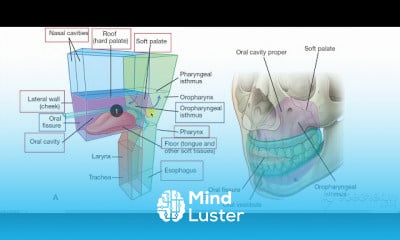
The oral cavity, better known as the mouth, is the start of the alimentary canal. It has three major functions: Digestion – receives food, preparing it for digestion in the stomach and small intestine. Communication – modifies the sound produced in the larynx to create a range of sounds. Breathing – acts as an air inlet in addition to the nasal cavity. In this article, we shall look at the anatomy of the oral cavity – its divisions, contents, and any clinical correlations. The oral cavity spans between the oral fissure (anteriorly – the opening between the lips), and the oropharyngeal isthmus (posteriorly – the opening of the oropharynx). It is divided into two parts by the upper and lower dental arches (formed by the teeth and their bony scaffolding). The two divisions of the oral cavity are the vestibule and the mouth cavity proper. Vestibule The horseshoe-shaped vestibule is situated anteriorly. It is the space between the lips/cheeks, and the gums/teeth. The vestibule communicates with the mouth proper via the space behind the third molar tooth, and with the exterior through the oral fissure. The diameter of the oral fissure is controlled by the muscles of facial expression – principally the orbicularis oris. Opposite the upper second molar tooth, the duct of the parotid gland opens out into the vestibule, secreting salivatory juices. What Are Oral Cavity and Oropharyngeal Cancers? Oral cavity cancer starts in the mouth. It might also be called oral cancer. Oropharyngeal cancer starts in the middle part of the throat just behind the oral cavity that can be seen when the mouth is open. Cancer starts when cells in the body start to grow out of control. To learn more about how cancers start and spread, see What Is Cancer? The oral cavity (mouth) and oropharynx (throat) The oral cavity includes the lips, the inside lining of the lips and cheeks (buccal mucosa), the teeth, the gums, the front two-thirds of the tongue, the floor of the mouth below the tongue, the bony roof of the mouth (hard palate) and the area behind the wisdom teeth (called the retromolar trigone). The oropharynx is the middle part of the throat just behind the oral cavity. It can be seen when your mouth is wide open. It includes the base of the tongue (the back third of the tongue), the soft palate (the back part of the roof of the mouth), the tonsils, and the side and back walls of the throat. The oral cavity and oropharynx help you breathe, talk, eat, chew, and swallow. Minor salivary glands all over the oral cavity and oropharynx make saliva (spit) that keeps your mouth and throat moist and helps you digest food. Ask your doctor to explain or show you where your cancer is. Explore the 3D interactive model here to learn more.
 To Register in Course you have to watch at least 30 Second of any lesson
 Identify the anatomical divisions and structures of the oral cavity and oropharynx for clinical assessment and diagnosis
Describe the functions of the oral cavity related to digestion, speech, and respiration in real-world contexts
Explain the clinical significance of oral cavity and oropharyngeal cancers, including risk factors and early detection methods
Demonstrate knowledge of the major contents of the oral cavity, including teeth, salivary glands, and mucosal linings
Apply anatomical knowledge to identify common oral cavity pathologies and their symptoms in clinical practice
Utilize 3D models and visual aids to enhance understanding of oral cavity anatomy and its clinical correlations
Assess the impact of oral cavity structures on speech production and breathing in practical scenarios
Recognize the importance of oral hygiene and early signs of oral diseases for effective patient education
Integrate anatomical and functional knowledge to support diagnosis and treatment planning for oral and oropharyngeal conditions
Develop skills to communicate complex oral cavity anatomy and pathology effectively to patients and healthcare teams
32 Lessons • 2 h 23 m total
 You must have an
Account
on the platform.
Complete all lessons.
Watch at least 50% of Lesson Duration.
Get your Certificate free 🎉 !
4.3
 (29 reviews)
Overall rating

Be the First One Review This Course
nice

good

Great and useful

ماعندي

4 lessons don't open. This is disappointed

I was very happy to join this course and I got to learn many techniques in this course.

Very Good
Esta muy bueno el curso
Gut
Gooooood
great
Good course but for better understanding it should be in English so that everyone can understand easily.

The oral cavity, better known as the mouth, is the start of the alimentary canal. It has three major functions: Digestion – receives food, preparing it for digestion in the stomach and small intestine. Communication – modifies the sound produced in the larynx to create a range of sounds. Breathing – acts as an air inlet in addition to the nasal cavity. In this article, we shall look at the anatomy of the oral cavity – its divisions, contents, and any clinical correlations. The oral cavity spans between the oral fissure (anteriorly – the opening between the lips), and the oropharyngeal isthmus (posteriorly – the opening of the oropharynx). It is divided into two parts by the upper and lower dental arches (formed by the teeth and their bony scaffolding). The two divisions of the oral cavity are the vestibule and the mouth cavity proper. Vestibule The horseshoe-shaped vestibule is situated anteriorly. It is the space between the lips/cheeks, and the gums/teeth. The vestibule communicates with the mouth proper via the space behind the third molar tooth, and with the exterior through the oral fissure. The diameter of the oral fissure is controlled by the muscles of facial expression – principally the orbicularis oris. Opposite the upper second molar tooth, the duct of the parotid gland opens out into the vestibule, secreting salivatory juices. What Are Oral Cavity and Oropharyngeal Cancers? Oral cavity cancer starts in the mouth. It might also be called oral cancer. Oropharyngeal cancer starts in the middle part of the throat just behind the oral cavity that can be seen when the mouth is open. Cancer starts when cells in the body start to grow out of control. To learn more about how cancers start and spread, see What Is Cancer? The oral cavity (mouth) and oropharynx (throat) The oral cavity includes the lips, the inside lining of the lips and cheeks (buccal mucosa), the teeth, the gums, the front two-thirds of the tongue, the floor of the mouth below the tongue, the bony roof of the mouth (hard palate) and the area behind the wisdom teeth (called the retromolar trigone). The oropharynx is the middle part of the throat just behind the oral cavity. It can be seen when your mouth is wide open. It includes the base of the tongue (the back third of the tongue), the soft palate (the back part of the roof of the mouth), the tonsils, and the side and back walls of the throat. The oral cavity and oropharynx help you breathe, talk, eat, chew, and swallow. Minor salivary glands all over the oral cavity and oropharynx make saliva (spit) that keeps your mouth and throat moist and helps you digest food. Ask your doctor to explain or show you where your cancer is. Explore the 3D interactive model here to learn more.
Experience the full power of Mindluster with Premium.
No distractions, just pure education.
Cancel your subscription anytime