
 100 Lessons
 207 Students


Divya Sree K
It is very useful videos but for me some of the videos are opening.
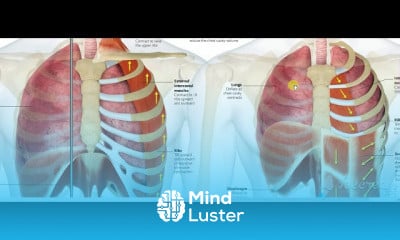
The respiratory system (also respiratory apparatus, ventilatory system) is a biological system consisting of specific organs and structures used for gas exchange in animals and plants. The anatomy and physiology that make this happen varies greatly, depending on the size of the organism, the environment in which it lives and its evolutionary history. In land animals the respiratory surface is internalized as linings of the lungs. Gas exchange in the lungs occurs in millions of small air sacs; in mammals and reptiles these are called alveoli, and in birds they are known as atria. These microscopic air sacs have a very rich blood supply, thus bringing the air into close contact with the blood. These air sacs communicate with the external environment via a system of airways, or hollow tubes, of which the largest is the trachea, which branches in the middle of the chest into the two main bronchi. These enter the lungs where they branch into progressively narrower secondary and tertiary bronchi that branch into numerous smaller tubes, the bronchioles. In birds the bronchioles are termed parabronchi. It is the bronchioles, or parabronchi that generally open into the microscopic alveoli in mammals and atria in birds. Air has to be pumped from the environment into the alveoli or atria by the process of breathing which involves the muscles of respiration. In most fish, and a number of other aquatic animals (both vertebrates and invertebrates) the respiratory system consists of gills, which are either partially or completely external organs, bathed in the watery environment. This water flows over the gills by a variety of active or passive means. Gas exchange takes place in the gills which consist of thin or very flat filaments and lammelae which expose a very large surface area of highly vascularized tissue to the water. Other animals, such as insects, have respiratory systems with very simple anatomical features, and in amphibians even the skin plays a vital role in gas exchange. Plants also have respiratory systems but the directionality of gas exchange can be opposite to that in animals. The respiratory system in plants includes anatomical features such as stomata, that are found in various parts of the plant.
 To Register in Course you have to watch at least 30 Second of any lesson
 Understand the anatomy and physiology of the human respiratory system, including lungs, alveoli, and airways for effective gas exchange
Identify different respiratory structures across animals and plants, such as gills, trachea, parabronchi, and stomata, for diverse gas exchange mechanisms
Explain the process of breathing and muscle involvement in ventilation for mammals, reptiles, birds, and amphibians
Analyze how respiratory surfaces adapt to environmental conditions and organism size in aquatic and terrestrial species
Describe the role of blood supply and vascularization in facilitating efficient gas exchange in respiratory organs
Compare respiratory systems of fish, insects, amphibians, and plants to understand evolutionary adaptations and functional diversity
Evaluate the impact of respiratory system structure on organism survival, activity levels, and environmental interactions
Apply knowledge of respiratory anatomy and physiology to diagnose respiratory health issues and conditions
100 Lessons • 8 h 5 m total

 You must have an
Account
on the platform.
Complete all lessons.
Watch at least 50% of Lesson Duration.
Get your Certificate free 🎉 !
4.6
 (9 reviews)
Overall rating

Be the First One Review This Course
It is very useful videos but for me some of the videos are opening.

EXCELENT
very easy to understand
Great tution
The lessons are not thought in English so I'm not able to understand anything said by the instructor. <br /> It will be good to have the lessons in various languages to help learners

Excellent
great course
I m unable to understand lectureres language

GOOD

The respiratory system (also respiratory apparatus, ventilatory system) is a biological system consisting of specific organs and structures used for gas exchange in animals and plants. The anatomy and physiology that make this happen varies greatly, depending on the size of the organism, the environment in which it lives and its evolutionary history. In land animals the respiratory surface is internalized as linings of the lungs. Gas exchange in the lungs occurs in millions of small air sacs; in mammals and reptiles these are called alveoli, and in birds they are known as atria. These microscopic air sacs have a very rich blood supply, thus bringing the air into close contact with the blood. These air sacs communicate with the external environment via a system of airways, or hollow tubes, of which the largest is the trachea, which branches in the middle of the chest into the two main bronchi. These enter the lungs where they branch into progressively narrower secondary and tertiary bronchi that branch into numerous smaller tubes, the bronchioles. In birds the bronchioles are termed parabronchi. It is the bronchioles, or parabronchi that generally open into the microscopic alveoli in mammals and atria in birds. Air has to be pumped from the environment into the alveoli or atria by the process of breathing which involves the muscles of respiration. In most fish, and a number of other aquatic animals (both vertebrates and invertebrates) the respiratory system consists of gills, which are either partially or completely external organs, bathed in the watery environment. This water flows over the gills by a variety of active or passive means. Gas exchange takes place in the gills which consist of thin or very flat filaments and lammelae which expose a very large surface area of highly vascularized tissue to the water. Other animals, such as insects, have respiratory systems with very simple anatomical features, and in amphibians even the skin plays a vital role in gas exchange. Plants also have respiratory systems but the directionality of gas exchange can be opposite to that in animals. The respiratory system in plants includes anatomical features such as stomata, that are found in various parts of the plant.
Experience the full power of Mindluster with Premium.
No distractions, just pure education.
Cancel your subscription anytime