
 26 Lessons
 34 Students


Zane Vīksna
was good
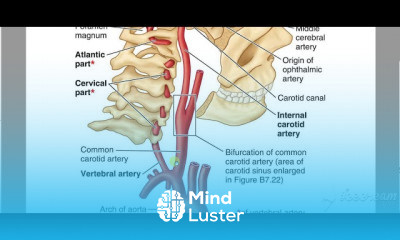
The head and neck receives the majority of its blood supply through the carotid and vertebral arteries. This article shall explore the anatomy of this arterial system – its anatomical course, branches, and clinical correlations. Carotid Arteries We shall start at the origin of the carotid arteries. The right common carotid artery arises from a bifurcation of the brachiocephalic trunk (the right subclavian artery is the other branch). This bifurcation occurs roughly at the level of the right sternoclavicular joint. The left common carotid artery branches directly from the arch of aorta. The left and right common carotid arteries ascend up the neck, lateral to the trachea and the oesophagus. They do not give off any branches in the neck. At the level of the superior margin of the thyroid cartilage (C4), the carotid arteries split into the external and internal carotid arteries. This bifurcation occurs in an anatomical area known as the carotid triangle. The common carotid and internal carotid are slightly dilated here, this area is known as the carotid sinus, and is important in detecting and regulating blood pressure. What blood vessels are in the neck? Two pairs of blood vessels in the neck — the carotid and vertebral arteries, known collectively as the cervical arteries — carry blood to the brain. A tear in the lining of one of these vessels is called a cervical artery dissection. What major artery is in the neck? There are two large arteries in the neck, one on each side. They are the carotid arteries, and they carry blood to the brain. If one of them is narrowed or blocked, it can lead to a stroke. Doctors can test for a narrowed carotid artery, but it's usually not a good idea.
 To Register in Course you have to watch at least 30 Second of any lesson
 Identify the origin and anatomical course of the right and left common carotid arteries in the neck and their relation to surrounding structures
Describe the bifurcation of the carotid arteries into external and internal branches at the carotid triangle and its clinical significance
Explain the function of the carotid sinus in blood pressure regulation and its anatomical location at C4 level
Analyze the blood supply to the brain through the carotid and vertebral arteries, including their clinical importance in stroke and cervical artery dissection
Recognize the anatomical features and clinical relevance of the carotid arteries in diagnosing and managing vascular diseases of the neck
Illustrate the relationship between the carotid arteries and adjacent structures such as the trachea, oesophagus, and thyroid cartilage
Evaluate the implications of carotid artery narrowing or blockage on cerebral blood flow and stroke risk
Describe the process and significance of carotid artery testing in assessing vascular health and stroke prevention
Differentiate between the external and internal carotid arteries in terms of their branches and functions in head and neck circulation
Apply anatomical knowledge of neck vessels to clinical procedures such as carotid endarterectomy and ultrasound imaging
26 Lessons • 1 h 57 m total
 You must have an
Account
on the platform.
Complete all lessons.
Watch at least 50% of Lesson Duration.
Get your Certificate free 🎉 !
4.0
 (191 reviews)
Overall rating

Be the First One Review This Course
was good

The head and neck receives the majority of its blood supply through the carotid and vertebral arteries. This article shall explore the anatomy of this arterial system – its anatomical course, branches, and clinical correlations. Carotid Arteries We shall start at the origin of the carotid arteries. The right common carotid artery arises from a bifurcation of the brachiocephalic trunk (the right subclavian artery is the other branch). This bifurcation occurs roughly at the level of the right sternoclavicular joint. The left common carotid artery branches directly from the arch of aorta. The left and right common carotid arteries ascend up the neck, lateral to the trachea and the oesophagus. They do not give off any branches in the neck. At the level of the superior margin of the thyroid cartilage (C4), the carotid arteries split into the external and internal carotid arteries. This bifurcation occurs in an anatomical area known as the carotid triangle. The common carotid and internal carotid are slightly dilated here, this area is known as the carotid sinus, and is important in detecting and regulating blood pressure. What blood vessels are in the neck? Two pairs of blood vessels in the neck — the carotid and vertebral arteries, known collectively as the cervical arteries — carry blood to the brain. A tear in the lining of one of these vessels is called a cervical artery dissection. What major artery is in the neck? There are two large arteries in the neck, one on each side. They are the carotid arteries, and they carry blood to the brain. If one of them is narrowed or blocked, it can lead to a stroke. Doctors can test for a narrowed carotid artery, but it's usually not a good idea.
Experience the full power of Mindluster with Premium.
No distractions, just pure education.
Cancel your subscription anytime