
 18 Lessons
 31 Students


The infrahyoid muscles, or strap muscles, are a group of four pairs of muscles in the anterior (frontal) part of the neck. The four infrahyoid muscles are the sternohyoid, sternothyroid, thyrohyoid and omohyoid muscles Excluding the sternothyroid, the infrahyoid muscles either originate from or insert on to the hyoid bone. The term infrahyoid refers to the region below the hyoid bone, while the term strap muscles refers to the long and flat muscle shapes which resembles a strap. The stylopharyngeus muscle is considered by many to be one of the strap muscles,[citation needed] but is not an infrahyoid muscle. The infrahyoid muscles are a group of four paired muscles that lie inferiorly to the hyoid bone in the anterior aspect of neck. This group of muscles is also known as strap muscles. They connect hyoid, sternum, clavicle and scapula. Infrahyoid muscles are organised in two layers. Superficial layer consist of sternohyoid and omohyoid whereas deep layer contain sternothyroid and thyrohyoid. The muscles are involved in movements of the hyoid bone and thyroid cartilage during vocalization, swallowing and mastication.It play an active role in swallowing through the movement of the larynx. They are mainly innervated from the ansa cervicalis. The suprahyoid muscles are a group of four muscles located superior to the hyoid bone of the neck. They all act to elevate the hyoid bone – an action involved in swallowing. The arterial supply to these muscles is via branches of the facial artery, occipital artery, and lingual artery. In this article, we shall look at the anatomy of the suprahyoid muscles – their attachments, actions, and innervation.
 To Register in Course you have to watch at least 30 Second of any lesson
What You'll Learn
-
 Identify the four pairs of infrahyoid muscles and their anatomical positions in the neck.
-
Describe the origin, insertion, and innervation of each infrahyoid muscle.
-
Explain the role of infrahyoid muscles in swallowing, vocalization, and laryngeal movement.
-
Differentiate between superficial and deep layers of infrahyoid muscles and their functions.
-
Analyze the blood supply to infrahyoid muscles from facial, occipital, and lingual arteries.
-
Illustrate the relationship between infrahyoid muscles and surrounding neck structures, including the hyoid bone and thyroid cartilage.
-
Demonstrate practical techniques for palpating infrahyoid muscles during clinical examination.
-
Apply knowledge of infrahyoid muscle anatomy to diagnose and treat neck and throat disorders.
Course Content
18 Lessons • 1 h 17 m total

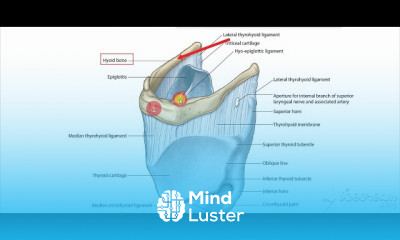
Hyoid bone
Mylohyoid muscle
Mylohyoid Vs Geniohyoid
Digastric muscle
Stylohyoid muscle
Nerve supply to suprahyoid muscles
Genioglossus muscle
Hyoglossus muscle
Hyoglossus muscle relations
Hyoglossus muscle superficial relations
Hyoglossus muscle deep relations
Hypoglossal nerve 1
Tongue muscles Innervation
Omohyoid muscle
Sternohyoid sternothyroid thyrohyoid
Infrahyoid muscles lateral view
Warning
Warning 2
How to Get The Certificate
-
You must have an
Account
on the platform.
-
Complete all lessons.
-
Watch at least 50% of Lesson Duration.
-
Get your Certificate free 🎉 !
4.7
 (198 reviews)
Overall rating

Reviews
Be the First One Review This Course
Related Courses
View All
















Hyoid Muscles Course Description
The infrahyoid muscles, or strap muscles, are a group of four pairs of muscles in the anterior (frontal) part of the neck. The four infrahyoid muscles are the sternohyoid, sternothyroid, thyrohyoid and omohyoid muscles Excluding the sternothyroid, the infrahyoid muscles either originate from or insert on to the hyoid bone. The term infrahyoid refers to the region below the hyoid bone, while the term strap muscles refers to the long and flat muscle shapes which resembles a strap. The stylopharyngeus muscle is considered by many to be one of the strap muscles,[citation needed] but is not an infrahyoid muscle. The infrahyoid muscles are a group of four paired muscles that lie inferiorly to the hyoid bone in the anterior aspect of neck. This group of muscles is also known as strap muscles. They connect hyoid, sternum, clavicle and scapula. Infrahyoid muscles are organised in two layers. Superficial layer consist of sternohyoid and omohyoid whereas deep layer contain sternothyroid and thyrohyoid. The muscles are involved in movements of the hyoid bone and thyroid cartilage during vocalization, swallowing and mastication.It play an active role in swallowing through the movement of the larynx. They are mainly innervated from the ansa cervicalis. The suprahyoid muscles are a group of four muscles located superior to the hyoid bone of the neck. They all act to elevate the hyoid bone – an action involved in swallowing. The arterial supply to these muscles is via branches of the facial artery, occipital artery, and lingual artery. In this article, we shall look at the anatomy of the suprahyoid muscles – their attachments, actions, and innervation.
Focus on Learning, Not Ads
Experience the full power of Mindluster with Premium.
No distractions, just pure education.
Cancel your subscription anytime
