
 13 Lessons
 995 Students



mehdi
very good
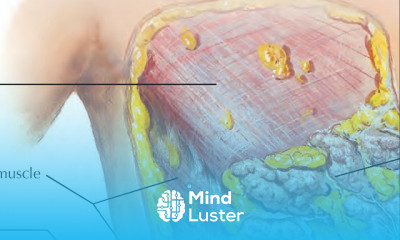
A fascia is a band or sheet of connective tissue, primarily collagen, beneath the skin that attaches to, stabilizes, encloses, and separates muscles and other internal organs. Fascia is classified by layer, as superficial fascia, deep fascia, and visceral or parietal fascia, or by its function and anatomical location. Like ligaments, aponeuroses, and tendons, fascia is made up of fibrous connective tissue containing closely packed bundles of collagen fibers oriented in a wavy pattern parallel to the direction of pull. Fascia is consequently flexible and able to resist great unidirectional tension forces until the wavy pattern of fibers has been straightened out by the pulling force. These collagen fibers are produced by fibroblasts located within the fascia. Fasciae are similar to ligaments and tendons as they have collagen as their major component. They differ in their location and function: ligaments join one bone to another bone, tendons join muscle to bone, and fasciae surround muscles and other structures. Superficial fascia is the lowermost layer of the skin in nearly all of the regions of the body, that blends with the reticular dermis layer It is present on the face, over the upper portion of the sternocleidomastoid, at the nape of the neck, and overlying the breastbone It consists mainly of loose areolar, and fatty adipose connective tissue and is the layer that primarily determines the shape of a body.[medical citation needed] In addition to its subcutaneous presence, superficial fascia surrounds organs and glands, neurovascular bundles, and is found at many other locations where it fills otherwise unoccupied space. It serves as a storage medium of fat and water; as a passageway for lymph, nerve and blood vessels; and as a protective padding to cushion and insulate. Superficial fascia is present, but does not contain fat, in the eyelid, ear, scrotum, penis and clitoris. Due to its viscoelastic properties, superficial fascia can stretch to accommodate the deposition of adipose that accompanies both ordinary and prenatal weight gain. After pregnancy and weight loss, the superficial fascia slowly reverts to its original level of tension.
 To Register in Course you have to watch at least 30 Second of any lesson
 Identify the different types of skin fascia and their specific functions in the human body
Describe the structural composition and collagen fiber arrangement in various fascia layers for flexibility and tension resistance
Explain the anatomical locations and distinctions between superficial, deep, and visceral fasciae in relation to muscles and organs
Assess the role of fascia in body shape, movement, and protection through its connective tissue properties
Apply knowledge of fascia to clinical practices such as manual therapy, massage, and rehabilitation techniques
Evaluate the significance of fascia in maintaining tissue hydration, flexibility, and overall musculoskeletal health
Demonstrate techniques for palpating and assessing fascia health and mobility in practical settings
Integrate fascia knowledge into holistic approaches for injury prevention, postural correction, and physical therapy
13 Lessons • 1 h 1 m total
You must have an
Account
on the platform.
Complete all lessons.
Watch at least 50% of Lesson Duration.
Get your Certificate free 🎉 !
4.3
 (123 reviews)
Overall rating

Be the First One Review This Course
very good
good!

muy interesante
good
Good

<3

Super

Good silks
Why it's not written in English

Nice knowledgeable easy to understand
Good

Great

A fascia is a band or sheet of connective tissue, primarily collagen, beneath the skin that attaches to, stabilizes, encloses, and separates muscles and other internal organs. Fascia is classified by layer, as superficial fascia, deep fascia, and visceral or parietal fascia, or by its function and anatomical location. Like ligaments, aponeuroses, and tendons, fascia is made up of fibrous connective tissue containing closely packed bundles of collagen fibers oriented in a wavy pattern parallel to the direction of pull. Fascia is consequently flexible and able to resist great unidirectional tension forces until the wavy pattern of fibers has been straightened out by the pulling force. These collagen fibers are produced by fibroblasts located within the fascia. Fasciae are similar to ligaments and tendons as they have collagen as their major component. They differ in their location and function: ligaments join one bone to another bone, tendons join muscle to bone, and fasciae surround muscles and other structures. Superficial fascia is the lowermost layer of the skin in nearly all of the regions of the body, that blends with the reticular dermis layer It is present on the face, over the upper portion of the sternocleidomastoid, at the nape of the neck, and overlying the breastbone It consists mainly of loose areolar, and fatty adipose connective tissue and is the layer that primarily determines the shape of a body.[medical citation needed] In addition to its subcutaneous presence, superficial fascia surrounds organs and glands, neurovascular bundles, and is found at many other locations where it fills otherwise unoccupied space. It serves as a storage medium of fat and water; as a passageway for lymph, nerve and blood vessels; and as a protective padding to cushion and insulate. Superficial fascia is present, but does not contain fat, in the eyelid, ear, scrotum, penis and clitoris. Due to its viscoelastic properties, superficial fascia can stretch to accommodate the deposition of adipose that accompanies both ordinary and prenatal weight gain. After pregnancy and weight loss, the superficial fascia slowly reverts to its original level of tension.
Experience the full power of Mindluster with Premium.
No distractions, just pure education.
Cancel your subscription anytime