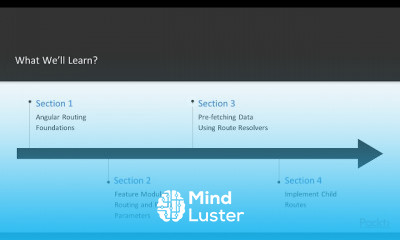

 7 Lessons
 1 Students


At the basic level, routing allows angular to display different "pages" or components. You probably want to have it, if you want to navigate across pages in your application. It shouldn't hurt anything if you add it, but don't .
 To Register in Course you have to watch at least 30 Second of any lesson
What You'll Learn
-
 Implement Angular routing to navigate between components and pages effectively in web applications
-
Configure Angular routes, including nested and parameterized routes, for dynamic content display
-
Utilize Angular router features such as guards, resolvers, and lazy loading to optimize application performance
-
Create and manage navigation links, router outlets, and route parameters for seamless user experience
-
Handle route parameters and query strings to pass data between components in Angular applications
-
Debug and troubleshoot Angular routing issues to ensure smooth navigation and application stability
Course Content
7 Lessons • 48 m total

Learning C 8 and NET Core 3 0 Course Overview | packtpub com
Learning C 8 and NET Core 3 0 Creating Feature Module | packtpub com
Learning C 8 and NET Core 3 0 Implementing Route Resolver | packtpub com
Learning C 8 and NET Core 3 0 Understanding Child Routes | packtpub com
Learning C 8 and NET Core 3 0 Creating Secondary Route | packtpub com
How to Get The Certificate
-
You must have an
Account
on the platform.
-
Complete all lessons.
-
Watch at least 50% of Lesson Duration.
-
Get your Certificate free 🎉 !
4.8
 (82 reviews)
Overall rating

Reviews
Be the First One Review This Course
Related Courses
View All

















Hands On Angular Routing Course Description
At the basic level, routing allows angular to display different "pages" or components. You probably want to have it, if you want to navigate across pages in your application. It shouldn't hurt anything if you add it, but don't .
Focus on Learning, Not Ads
Experience the full power of Mindluster with Premium.
No distractions, just pure education.
Cancel your subscription anytime
