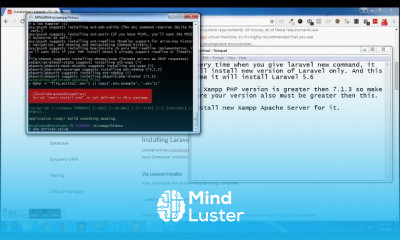
advanced Laravel Programming Course

 (93 reviews)
-
 768 Lessons
-
 3 Students
- Certificate of completion


Laravel comes with a complete authentication system that you only have to configure for your own application. It has an Object Relational Mapping (ORM) library called Eloquent that allows developers to interact with types of relational databases using only PHP. Eloquent will generate the SQL to query a database for you in most cases. Laravel also uses Artisan, which has built-in commands you can use to generate a lot of the application code automatically.
 To Register in Course you have to watch at least 30 Second of any lesson
What You'll Learn
-
 Master advanced Laravel features including authentication, middleware, and security best practices for robust web applications
-
Implement complex database interactions using Eloquent ORM, migrations, and query building for scalable Laravel projects
-
Utilize Laravel Artisan commands to automate code generation, database migrations, and application scaffolding efficiently
-
Develop custom middleware to handle user authentication, authorization, and request filtering effectively
-
Optimize Laravel applications for performance, caching, and database query efficiency in real-world scenarios
-
Integrate third-party APIs and services seamlessly within Laravel for enhanced application functionality
-
Implement advanced routing techniques, including route model binding and resource controllers, for clean code architecture
-
Secure Laravel applications by implementing best practices for data validation, CSRF protection, and user authentication
-
Create reusable Blade components and layouts to streamline frontend development in Laravel projects
-
Configure and manage Laravel environment settings for different deployment stages and environments
-
Implement event-driven programming with Laravel events, listeners, and queues for scalable background processing
-
Develop RESTful APIs using Laravel, including resource controllers, API authentication, and versioning strategies
-
Utilize Laravel’s testing tools to write unit, feature, and integration tests for reliable application deployment
-
Manage database relationships, eager loading, and data seeding to optimize data retrieval and application performance
-
Implement real-time features using Laravel broadcasting, WebSockets, and Pusher integrations
-
Apply best practices for deploying Laravel applications on cloud platforms, including server configuration and environment management
Course Content
768 Lessons • 318 h 32 m total

Laravel Tutorial Installing Laravel 5 6 from scratch
Laravel Tutorial Use GIT BASH to install and run Laravel
Laravel Tutorial Quickly add coming soon page up and down the website in Laravel 5 6
Laravel Tutorial Run muliple laravel projects offline
1 Make Admin Panel in Laravel 5 6 | Installation | Download Free Admin Design Template
2 Make Admin Panel in Laravel 5 6 | Copy Matrix Admin Template to Laravel
3 Make Admin Panel in Laravel 5 6 | Admin Login View
4 Make Admin Panel in Laravel 5 6 | Default Laravel Login process with Laravel Migration
5 Make Admin Panel in Laravel 5 6 | Use Laravel Default Login process for Admin Login
6 Make Admin Panel in Laravel 5 6 | Set Admin Dashboard | Header | Footer
7 Make Admin Panel in Laravel 5 6 | Display Error Message on Login Failure | Logout Process
8 Make Admin Panel in Laravel 5 6 | Protect Admin Routes | Secure Dashboard Route
9 Make Admin Panel in Laravel 5 6 | Settings Page | Update Password Form
10 Make Admin Panel in Laravel 5 6 | Check Current Password with JQuery Ajax
11 Make Admin Panel in Laravel 5 6 | Update Admin Password
1 Make E commerce website in Laravel 5 6 | 12 Admin Panel | Categories | Migrations | CRUD
2 Make E commerce website in Laravel 5 6 | 13 Admin Panel | Display Categories with Datatables
3 Make E commerce website in Laravel 5 6 | 14 Admin Panel | Edit Categories
Part 1 Create table with Migration Laravel 5 6 Migrations
Part 2 Update table with Migration Laravel 5 6 Migrations
4 Make E commerce website in Laravel 5 6 | 15 Admin Panel | Delete Categories
Part 3 Insert data in table with Migration Laravel 5 6 Migrations
5 Make E commerce website in Laravel 5 6 | 16 Admin Panel | Add Sub Categories to Categories
Part 4 Update data in table with Migration Laravel 5 6 Migrations
6 Make E commerce website in Laravel 5 6 | 17 Admin Panel | Products Section | Laravel Migrations
7 Make E commerce website in Laravel 5 6 | 18 Admin Panel | Add Product | Validations
8 Make E com website in Laravel 5 6 | 19 Admin Panel | Add Product Image | Intervention Package
Part 5 Migration Commands Laravel 5 6 Migrations
9 Make E commerce website in Laravel 5 6 | 20 Admin Panel | View Products | Datatables
10 Make E commerce website in Laravel 5 6 | 21 Admin Panel | Product Details | Modal Pop up
11 Make E commerce website in Laravel 5 6 | 22 Admin Panel | Edit Products
12 Make E commerce website in Laravel 5 6 | 23 Admin Panel | Show Update Delete Product Images
13 Make E commerce website in Laravel 5 6 | 24 Admin Panel | Delete Products | SweetAlert
14 Make E commerce website in Laravel 5 6 | 25 Admin Panel | SweetAlert for Categories Deletion
15 Make E commerce website in Laravel 5 6 | 26 Admin Panel | Products Attributes
16 Make E commerce website in Laravel 5 6 | 27 Admin Panel | Products Attributes
17 Make E commerce website in Laravel 5 6 | 28 Admin Panel | Products Attributes
18 Make E commerce website in Laravel 5 6 | 29 Admin Panel | Products Attributes
19 Make E com website in Laravel 5 6 | 30 Admin Panel | Products Attributes | Delete | SweetAlert
20 Make E com website in Laravel 5 6 | 31 Admin Panel | Download Free E Shop Template

How to Get The Certificate
-
You must have an
Account
on the platform.
-
Complete all lessons.
-
Watch at least 50% of Lesson Duration.
-
Get your Certificate free 🎉 !
4.1
(93 reviews)
Overall rating

Reviews
Be the First One Review This Course
Related Courses
View All




advanced Laravel Programming Course Description
Laravel comes with a complete authentication system that you only have to configure for your own application. It has an Object Relational Mapping (ORM) library called Eloquent that allows developers to interact with types of relational databases using only PHP. Eloquent will generate the SQL to query a database for you in most cases. Laravel also uses Artisan, which has built-in commands you can use to generate a lot of the application code automatically.
Focus on Learning, Not Ads
Experience the full power of Mindluster with Premium.
No distractions, just pure education.
Cancel your subscription anytime
