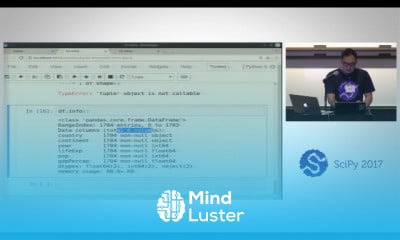
Scientific Computing with Python Course

 (130 reviews)
-
 91 Lessons
-
 21 Students
- Certificate of completion


In the Scientific Computing with Python Certification, you'll learn Python fundamentals like variables, loops, conditionals, and functions. Then you'll quickly ramp up to complex data structures, networking, relational databases, and data visualization.
 To Register in Course you have to watch at least 30 Second of any lesson
What You'll Learn
-
 Master Python variables, loops, conditionals, and functions for scientific computing applications
-
Implement advanced data structures to efficiently manage large datasets in Python
-
Develop data visualization skills using Python libraries for scientific and analytical insights
-
Utilize Python for networking tasks and real-time data collection in scientific research
-
Design and query relational databases to organize and analyze scientific data effectively
-
Apply Python to process, analyze, and interpret complex scientific datasets
-
Create scripts to automate data analysis workflows in scientific computing projects
-
Integrate Python with scientific tools and libraries for enhanced computational performance
-
Implement best practices for debugging and optimizing Python code in scientific contexts
-
Use Python to develop simulations and models for scientific experiments and research
-
Leverage Python for data cleaning, transformation, and preprocessing in scientific studies
-
Build interactive visualizations to communicate scientific findings clearly and effectively
-
Utilize Python networking capabilities for remote data access and distributed computing
-
Apply Python data visualization techniques to identify patterns and trends in scientific data
-
Develop scalable Python solutions for handling large-scale scientific computations
-
Implement version control and documentation practices for reproducible scientific Python projects
Course Content
91 Lessons • 92 h 27 m total

Pandas for Data Analysis | SciPy 2017 Tutorial | Daniel Chen
Computational Statistics | SciPy 2017 Tutorial | Allen Downey
Dash A New Framework for Building User Interfaces for Technical Computing | SciPy 2017 | Chris Par
Machine Learning with scikit learn Part One | SciPy 2017 Tutorial | Andreas Mueller Alexandre Gram
Introduction to Numerical Computing with NumPy | SciPy 2017 Tutorial | Dillon Niederhut
Fully Convolutional Networks for Image Segmentation | SciPy 2017 | Daniil Pakhomov
Numba Tell Those C Bullies to Get Lost | SciPy 2017 Tutorial | Gil Forsyth Lorena Barba
Deploying Interactive Jupyter Dashboards for Visualizing Hundreds of Millions of Datapoints in 30 L
Anatomy of Matplotlib | SciPy 2017 Tutorial | Ben Root
The Jupyter Interactive Widget Ecosystem | SciPy 2017 Tutorial | Matt Craig Sylvain Corlay Jason
Python and Tableau Building an Interactive and Beautiful Data Visualization with TabPy | SciPy 201
Modern Optimization Methods in Python | SciPy 2017 Tutorial | Michael McKerns
Parallel Data Analysis in Python | SciPy 2017 Tutorial | Matthew Rocklin Ben Zaitlen Aron Ahmadia
scikit image Image Processing for Python | SciPy 2017 Tutorial | Stéfan van der Walt Emmanuelle
A Python API for Earth | SciPy 2017 | Sam Skillman
nbgrader A Tool for Creating and Grading Assignments in the Jupyter Notebook | SciPy 2017 | Jessic
Automatic Code Generation with SymPy | SciPy 2017 Tutorial | Jason Aaron Björn Kenneth
Machine Learning with scikit learn Part Two | SciPy 2017 Tutorial | Andreas Mueller Alexandre Gram
Dask Advanced Techniques | SciPy 2017 | Matthew Rocklin
Cython for Data Scientists and Data Scientists | SciPy 2017 Tutorial | Dillon Niederhut Prabhu
Interactive Data Visualization with HoloViews Bokeh | SciPy 2017 Tutorial | Jean Luc Stevens Bry
Software Carpentry Scientific Python Course Part 1 | SciPy 2017 Tutorial | Maxim Belkin
Parallelizing Scientific Python with Dask | SciPy 2017 Tutorial | James Crist
HDF5 take 2 h5py PyTables | SciPy 2017 Tutorial | Tom Kooij
Keynote Drilling the Chicxulub Impact Structure Study of Large Impact Formation and Effects
pomegranate | Fast and Flexible Probabilistic Modeling in Python | SciPy 2017 | Jacob Schreiber
Keynote Coding for Science and Innovation | SciPy 2017 | Gaël Varoquaux
SciSheets Providing the Power of Programming with the Simplicity of Spreadsheets | SciPy 2017 | Jo
The Spyder Ecosystem of Plugins | SciPy 2017 | Carlos Cordoba
Scientific Analysis at Scale a Comparison of Five Systems | SciPy 2017 | Jake VanderPlas
Deep Learning with Geospatial Data | SciPy 2017 | Shane Grigsby
Signal Processing and Communications Hands On Using scikit dsp comm | SciPy 2017 Tutorial | Mark Wic
Network Science and Statistics Fundamentals and Applications | SciPy 2017 Tutorial | Eric Ma
bqplot Seamless Interactive Visualizations in the Jupyter Notebook | SciPy 2017 | Dhruv Madeka
Big Data Processing with Apache Beam Python | SciPy 2017 | Robert Bradshaw
Optimised Finite Difference Computation from Symbolic Equations | SciPy 2017 | Michael Lange
Sacred How I Learned to Stop Worrying and Love the Research | SciPy 2017 | Klaus Greff
Bringing the Generic Mapping Tools to Python | SciPy 2017 | Leonardo Uieda Paul Wessel
Keynote Academic Open Source | SciPy 2017 | Kathryn Huff
MatchPy A Pattern Matching Library | SciPy 2017 | Manuel Krebber

How to Get The Certificate
-
You must have an
Account
on the platform.
-
Complete all lessons.
-
Watch at least 50% of Lesson Duration.
-
Get your Certificate free 🎉 !



4.2
(130 reviews)
Overall rating

Reviews
Be the First One Review This Course
Related Courses
View All



Scientific Computing with Python Course Description
In the Scientific Computing with Python Certification, you'll learn Python fundamentals like variables, loops, conditionals, and functions. Then you'll quickly ramp up to complex data structures, networking, relational databases, and data visualization.
Focus on Learning, Not Ads
Experience the full power of Mindluster with Premium.
No distractions, just pure education.
Cancel your subscription anytime
