Good
Number System Basics course in hindi, in this course Explore the fundamentals of various numerical representations, including decimal, binary, octal, and hexadecimal systems in this course.
To Register in Course you have to watch at least 30 Second of any lesson
What You'll Learn
-
Understand and convert between decimal, binary, octal, and hexadecimal number systems for digital electronics applications
-
Apply number system conversions to real-world digital circuit design and troubleshooting tasks
-
Identify the significance of binary and hexadecimal systems in digital electronics and computer architecture
-
Explain the role of number systems in digital logic, microprocessors, and embedded systems
-
Utilize number system representations to optimize digital data storage and transmission efficiency
-
Analyze digital signals and data using various numerical formats for accurate processing and interpretation
-
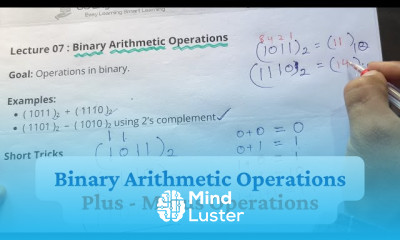
Implement binary arithmetic operations for digital circuit calculations and logic design
-
Differentiate between number systems to enhance debugging and error detection in digital systems
-
Use number system concepts to develop efficient algorithms for digital data encoding and decoding
-
Assess the impact of different number systems on digital system performance and reliability
-
Apply knowledge of number systems to design and analyze digital communication protocols
-
Demonstrate proficiency in converting and working with multiple number systems in practical digital electronics scenarios
Course Content
39 Lessons • 7 h 15 m total
Representation of Number Systems and Basics of Number System Binary Ternary Octal Hexadecimal
Addition operation in Different Number systems Binary Octal Hexadecimal Addition
Subtraction operation in Different Number Systems Binary Octal and Hexadecimal Subtraction
Octal and Binary Multiplication Number System Multiplication DigitalElectronics
Decimal to Binary Conversion Decimal to Binary Conversion Process and Examples DigitalElectronics
Decimal to Octal Conversion Decimal to Octal Conversion Process and Examples DigitalElectronics
Decimal to Hexadecimal Conversion Decimal to Hexadecimal Conversion Process and Examples
Octal Binary and Hexadecimal to Decimal conversion and Visa Versa DigitalElectronics
Hexadecimal to Binary to Octal conversion and Visa versa DigitalElectronics
X Number System to Y Number System conversion Number System Conversion DigitalElectronics
1 s 2 s Compliment 7 s 8 s Compliment 9 s 10 s Compliment and 15 s 16 s Compliment
Simple Signed Representation Example and Block Diagram of Simple Signed Representation
1 s compliment signed Representation Example Block diagram of 1 s compliment signed Representatio
2 s compliment signed Representation Example Blockdiagram of 2 s compliment signed Representation
1 s compliment signed Representation and 2 s compliment signed Representation Examples
Shortcut Method to find 2 s compliment 2 s Compliment Examples DigitalElectronics
Binary Subtraction using 1 s compliment Process of Binary Subtraction using 1 s compliment
Binary Subtraction using 2 s compliment Process of Binary Subtraction using 2 s compliment
Classification of Codes Definition Weighted Non Weighted Reflecting Sequential Alphanumeric
BCD code Binary Coded Decimal Code Binary and BCD Comparison Decimal to BCD Code Conversion
BCD Addition BCD Addition Rules BCD Addition Examples DigitalElectronics
BCD to Binary conversion BCD to Binary conversion Process BCD to Binary conversion Examples
Binary to BCD conversion Process of Binary to BCD conversion Binary to BCD conversion Examples
2421 BCD code and 2 421 BCD code Self Complimentary Property of 2421 BCD Code DigitalElectronics
Excess 3 Code Excess 3 Code Properties Decimal to Excess 3 Code Conversion DigitalElectronics
Excess 3 Addition Excess 3 Addition Process Excess 3 Addition Examples DigitalElectronics
Identification of self complimenting code Digital Electronics Digital Logic Design
ASCII code American Standard Code for Information Interchange DigitalElectronics
Gray Code Basics Properties Gray Code as self reflection code Gray Code as unit distance code
Binary to Gray code conversion Binary to Gray code conversion process and Examples
Gray to Binary Code conversion Gray to Binary Code conversion process and Examples
Identification of Base or Radix of given number Radix Identification Base Identification
Total bits required to represent a number Bits Identification for given number DigitalElectronics
Minimal Decimal Equivalent Minimal Decimal Equivalent Examples DigitalElectronics
Hamming Code Basics Number of Parity bits in Hamming code Find Parity bits in Hamming code
Hamming Code generation Position of Parity bits and Calculation of Parity bits in Hamming Code
Hamming Code error detection and Hamming Code error correction DigitalElectronics
IEEE 754 floating point single precision 32 bit format DigitalElectronics
IEEE 754 floating point double precision 64 bit format DigitalElectronics
How to Get The Certificate
-
You must have an Account on the platform.
-
Complete all lessons.
-
Watch at least 50% of Lesson Duration.
-
Get your Certificate free 🎉 !
4.1
(80 reviews)
Overall rating
Reviews
Be the First One Review This Course
Good 👍
Excellent
Good
nice
Good
Good
Good
happy
Good
Good
Good
Number System Basics in Digital Electronics Course Description
Number System Basics course in hindi, in this course Explore the fundamentals of various numerical representations, including decimal, binary, octal, and hexadecimal systems in this course.
Focus on Learning, Not Ads
Experience the full power of Mindluster with Premium.
No distractions, just pure education.
Cancel your subscription anytime