
 47 Lessons
 2.3K Students






Ashenafie Tesgaye
Perfect
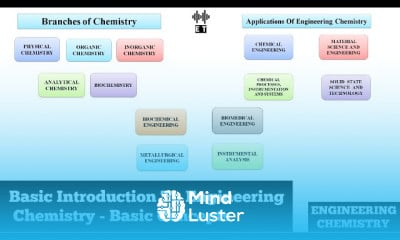
What are the 5 types of chemistry? Traditionally, chemistry has been broken into five main subdisciplines: Organic, Analytical, Physical, Inorganic and Biochemistry. What is chemistry in simple words? The definition of chemistry is a branch of science that deals with the form and properties of matter and substances or the interaction between individuals. An example of chemistry is the study of protons and neutrons. An example of chemistry is the feeling of affection and attraction between a couple. noun. How do you define chemistry? Chemistry, the science that deals with the properties, composition, and structure of substances (defined as elements and compounds), the transformations they undergo, and the energy that is released or absorbed during these processes. What are the 3 laws of chemistry? Laws of Chemistry The law of the conservation of mass. The law of constant proportions. The law of multiple proportions. The law of reciprocal proportions. Which branch of chemistry is best? Organic chemistry offers the maximum job opportunities. Though the industries of all these branches are different. Like if you have done specialization in physical chemistry than you should go for detergents, polymer based industries. Why is chemistry so important? Chemistry is important because everything you do is chemistry! Even your body is made of chemicals. Chemical reactions occur when you breathe, eat, or just sit there reading. All matter is made of chemicals, so the importance of chemistry is that it's the study of everything What is chemistry and its uses? Chemistry is a fundamental and enabling science that investigates molecules—the building blocks of all matter—and how they interact to affect the composition, structure and properties of substances. What are the characteristics of chemistry? Chemistry is the scientific discipline involved with elements and compounds composed of atoms, molecules and ions: their composition, structure, properties, behavior and the changes they undergo during a reaction with other substances.
 To Register in Course you have to watch at least 30 Second of any lesson
 Understand the fundamental concepts and definitions of chemistry, including matter, substances, and chemical interactions.
Identify and describe the five main subdisciplines of chemistry: organic, inorganic, analytical, physical, and biochemistry.
Explain the basic laws of chemistry, such as conservation of mass and proportions, and their significance in chemical reactions.
Apply chemical terminology and concepts to real-world examples, including everyday chemical processes and reactions.
Analyze the structure, properties, and behavior of elements, compounds, molecules, and ions in various chemical contexts.
Evaluate the importance of chemistry in industries like pharmaceuticals, polymers, and environmental science.
Demonstrate practical skills in conducting simple chemical experiments and analyzing chemical data.
Utilize chemistry principles to understand biological processes, such as metabolism and enzyme functions.
Assess the role of energy changes during chemical reactions and their applications in real-world scenarios.
Describe the significance of chemical laws and principles in scientific research and technological advancements.
Develop critical thinking skills to interpret chemical phenomena and solve related problems effectively.
Communicate complex chemical concepts clearly and accurately in written and verbal formats.
47 Lessons • 8 h 13 m total

 You must have an
Account
on the platform.
Complete all lessons.
Watch at least 50% of Lesson Duration.
Get your Certificate free 🎉 !
4.4
 (734 reviews)
Overall rating

Be the First One Review This Course
Perfect

GOOD

Excellent and very informative course, thank you!

good

good

Excellent course. I learned many useful chemistry concepts. Thank you, Mindluster.

good course

GOOD COURSE

Easy to understand
Easy to understand
Good and easy to unde

Good

What are the 5 types of chemistry? Traditionally, chemistry has been broken into five main subdisciplines: Organic, Analytical, Physical, Inorganic and Biochemistry. What is chemistry in simple words? The definition of chemistry is a branch of science that deals with the form and properties of matter and substances or the interaction between individuals. An example of chemistry is the study of protons and neutrons. An example of chemistry is the feeling of affection and attraction between a couple. noun. How do you define chemistry? Chemistry, the science that deals with the properties, composition, and structure of substances (defined as elements and compounds), the transformations they undergo, and the energy that is released or absorbed during these processes. What are the 3 laws of chemistry? Laws of Chemistry The law of the conservation of mass. The law of constant proportions. The law of multiple proportions. The law of reciprocal proportions. Which branch of chemistry is best? Organic chemistry offers the maximum job opportunities. Though the industries of all these branches are different. Like if you have done specialization in physical chemistry than you should go for detergents, polymer based industries. Why is chemistry so important? Chemistry is important because everything you do is chemistry! Even your body is made of chemicals. Chemical reactions occur when you breathe, eat, or just sit there reading. All matter is made of chemicals, so the importance of chemistry is that it's the study of everything What is chemistry and its uses? Chemistry is a fundamental and enabling science that investigates molecules—the building blocks of all matter—and how they interact to affect the composition, structure and properties of substances. What are the characteristics of chemistry? Chemistry is the scientific discipline involved with elements and compounds composed of atoms, molecules and ions: their composition, structure, properties, behavior and the changes they undergo during a reaction with other substances.
Experience the full power of Mindluster with Premium.
No distractions, just pure education.
Cancel your subscription anytime